
Waterproofing Company in Abu Dhabi
Dubai Technical Works is a waterproofing company in Abu Dhabi handling roofs, terraces, basements, bathrooms, water tanks, pools and podium decks across villas, towers and industrial sites. Systems start at AED 45 per sqm, a surveyor reaches active leaks within 24 to 48 hours, every membrane is flood-tested before anything goes back on top, and warranties run up to 10 years.
Call +971 55 711 3252 for a free leak survey.
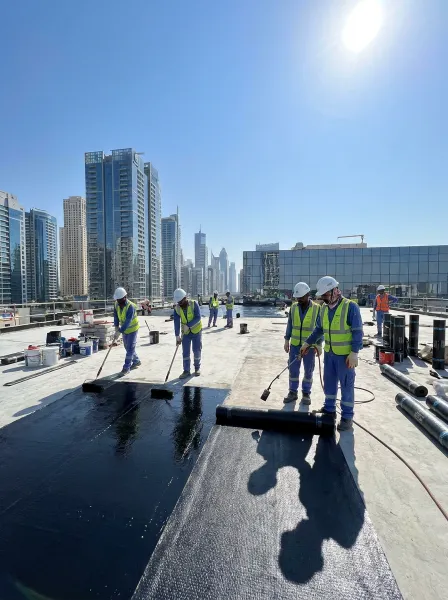
Waterproofing Services Across Abu Dhabi, Al Ain and Al Dhafra
We work on private villas, townhouses, apartment towers, offices, hotels, schools, clinics, warehouses, factories, labour accommodation and government facilities.
Two kinds of jobs come through. New construction waterproofing, applied to a fresh slab before screed and finishes. And remediation, where a building is already leaking, and somebody needs it stopped before the next tenant complaint.
Our clients include homeowners, landlords, tenants reporting leaks, facility management companies, main contractors, developers and building maintenance teams.
Coverage runs across Abu Dhabi Island and the central districts, out to Yas, Saadiyat, Reem and Al Raha, through Khalifa City and Mussafah, and into Al Ain and the Al Dhafra region. Our wider waterproofing division also covers Dubai and Sharjah.
Where We Waterproof
Roof and Terrace Waterproofing
Flat concrete roofs, rooftop terraces, parapets, roof drains and penetrations. Most roof failures we open up are not membrane failures at all. They are detail failures at the parapet upstand or around a rainwater outlet, where the membrane was never properly terminated. See roof waterproofing.
Basement and Substructure Waterproofing
Basement walls, foundation slabs, retaining walls and underground parking. Abu Dhabi’s water table sits high in many areas, so basements face constant hydrostatic pressure rather than occasional wetting. That rules out systems designed for positive-side protection only. More on basement waterproofing.
Bathroom and Wet Area Waterproofing
Bathroom floors, shower zones, walls, floor drains, and pipe penetrations. Water passes straight through grout, which is porous by design. The membrane under the tile is what stops it from reaching the slab. Full detail on bathroom waterproofing.
Water Tanks and GRP Lining
Concrete water tanks, base slabs, pipe penetrations and overflow channels lined in GRP. Tanks holding potable water need food-grade compliant linings, not whatever coating is on the van. We confirm the application before quoting.
Swimming Pools and Water Features
Pool shells, floors, walls, steps, skimmers and light niches. Pools fail at penetrations far more often than across the flat shell, so detailing around fittings matters more than the coating on the floor. See pool waterproofing.
Balconies, Podium Decks and Planter Boxes
Balcony slabs, balustrade fixings, podium decks over occupied space and landscaped planter boxes. Planters need a root barrier above the membrane. Without one, roots find the smallest lap and open it within a few seasons.
External Walls and Facades
Wall cracks, facade joints, window perimeters and exposed concrete. Wind-driven rain during the winter storm months pushes water through hairline cracks that look harmless in dry weather.
Industrial Floors and Epoxy Coatings
Warehouse floors, plant rooms, workshops, and loading areas in Mussafah and ICAD. Epoxy and polyurethane floor systems that resist chemical spills, forklift traffic, and washdown. See epoxy floor coating.
Expansion Joints and Crack Injection
Movement joints, construction joints, and structural cracks sealed with PU or epoxy injection. PU resin expands on contact with water, which makes it the right choice for a crack actively passing water rather than a dry one.
Find the Leak Before You Buy a Membrane
Thermal Imaging and Moisture Mapping
Thermal cameras show temperature differences where moisture sits inside a buildup, and moisture meters confirm the readings. Together they map the wet zone without opening up the whole roof.
Flood Testing and Dye Testing
We pond water on a suspect area and watch below. On bathrooms and balconies, this isolates the failure in 24 hours. Dye tracing works where water is entering a specific detail such as a drain or pipe penetration.
Source vs Symptom — Why the Stain Isn’t the Leak
Water tracks laterally across a slab or through a screed layer before it drops through a weak point. A stain in a third-floor ceiling can come from a terrace detail twenty metres away.
That is why treating the stain achieves nothing. It also means one in four jobs we survey turns out to be a plumbing or AC condensate fault rather than waterproofing, which our leak detection team picks up before anyone quotes a membrane.
Why Waterproofing Fails in Abu Dhabi
Roof Surface Temperatures Above 75°C
Ambient air hits the mid-40s in summer, but a dark exposed membrane on a flat roof runs far hotter. That heat load softens cheap bitumen, drives thermal movement through the slab and breaks down coatings that were never rated for it.
High Water Table and Hydrostatic Pressure
Much of Abu Dhabi sits on low-lying coastal ground with groundwater close to the surface. Basements and foundations face constant upward and lateral pressure, so negative-side treatments applied to the inside face of a wall get pushed off unless the system is designed for it.
Coastal Salinity, Sabkha Soil and Chloride Attack
Saline groundwater and sabkha conditions drive chlorides into concrete. Once they reach the reinforcement, the steel corrodes, expands, and cracks the structure from inside. Waterproofing is the barrier that interrupts that cycle, which is why below-ground failures here get expensive fast.
Detailing Failures at Upstands, Drains and Penetrations
Flat areas rarely fail. Upstands, drain collars, pipe penetrations, movement joints and membrane terminations fail constantly. A perfectly applied field membrane with a poorly detailed outlet still leaks.
Waterproofing Systems and Where Each Belongs
Torch-On Bituminous Membrane
Reinforced modified bitumen sheet, torch-applied in laps. The workhorse for concrete roofs and podium decks, especially under screed or ballast. Lifespan 15 to 20 years when properly detailed and protected. See membrane waterproofing.
Liquid Applied Polyurethane Membrane
Seamless, flexible, and able to bridge hairline cracks. Right for complex roof geometry with many penetrations where sheet laps become a liability. Lifespan: 10 to 15 years exposed.
Polyurea Spray Coating
Spray-applied, cures in seconds, extremely tough. Earns its place on large commercial roofs, car park decks and tanks where downtime costs real money. Highest cost, fastest return to service. See polyurea coating.
Cementitious and Polymer-Modified Systems
Brush or spray-applied cement slurry that bonds directly to concrete. Cost-effective for bathrooms, wet areas, and tanks under tile. Rigid, so it needs a stable substrate with no movement.
Crystalline Waterproofing for Concrete
Reactive chemicals that penetrate concrete and grow crystals inside the capillaries, sealing it from within. Works against negative-side pressure, which makes it valuable for basements and retaining walls. See crystalline waterproofing.
GRP Lining for Tanks and Wet Areas
Glass-reinforced polyester laminated in place, forming a jointless basin independent of the structure. The strongest option for water tanks, sunken slabs and pools that have already leaked.
Epoxy Floor Coatings
Chemical-resistant, hard-wearing floor systems for industrial units, plant rooms and workshops. Not a roof system, and anyone offering it as one has misread the specification.
PU and Epoxy Injection Grouting
Pressure-injected resin into cracks and construction joints. PU for active water, epoxy for structural bonding on dry cracks.
Combo and Insulated Roof Systems
Membrane plus thermal insulation in one build-up, which cuts roof surface temperature and helps on the thermal performance side of building compliance. We apply Sika, Mapei, Fosroc, Drizoro and BASF MasterSeal systems, and the product name goes on your quote. A quote that just says “waterproofing” is hiding the specification.
Overlay or Strip Out? The Existing Roof Decision
Overlay saves 30% to 40% against a full strip-out, and it works when the existing membrane is still bonded, the substrate below is dry, and the roof is structurally sound.
It fails when moisture is already trapped in the insulation or screed. Sealing a wet build-up under a new layer traps that water, and the first hot season drives it into blisters that lift the new membrane off.
We take core samples and check moisture content before recommending an overlay. Reading a roof from the surface is guessing, and it is why so many Abu Dhabi roofs have been overlaid twice and still leak.
Repair, Patch or Re-Waterproof?
An isolated detail failure on an otherwise sound membrane is a repair job. Expect AED 2,000 to 8,000 for a drain collar, an upstand or a localised tear.
Multiple failure points, or a membrane past its service life, mean replacement. Patching an aged system buys you one season, and you pay twice for screed, tile, or ballast reinstatement.
The test we apply: if we find failure in more than two separate details, or the membrane is past twelve years, we quote replacement and tell you why.
Transparent Waterproofing Prices in Abu Dhabi (2026)
Free Site Survey and Leak Investigation
The survey is free and takes 2 to 4 hours depending on the area. We inspect, thermal-scan where useful, take core samples where needed, identify the source, and issue a written report naming the cause, the recommended system, and a fixed price.
Waterproofing Price List
System | Price (AED/sqm) |
Cementitious coating | 45 – 90 |
Liquid applied PU membrane | 70 – 140 |
Torch-on bituminous membrane | 60 – 120 |
Polyurea spray coating | 160 – 320 |
GRP lining | 180 – 340 |
Epoxy floor coating | 90 – 220 |
Crystalline waterproofing | 55 – 110 |
Combo / insulated roof system | 130 – 260 |
Crack injection (per linear metre) | 220 – 550 |
Typical Project Costs
Project | Price (AED) |
Apartment bathroom | 2,800 – 7,500 |
Villa roof, 200sqm | 18,000 – 38,000 |
Apartment balcony | 3,500 – 9,000 |
Concrete water tank | 9,000 – 26,000 |
Basement car park | Quoted after survey |
Podium deck | Quoted after survey |
Warehouse roof, 1,000sqm | 70,000 – 160,000 |
What Changes the Quote
Access and working height move the price most, followed by whether the existing layer has to come off. After that: substrate repair, fall correction, insulation, reinstatement of screed and tile, and phasing around occupied space. We price reinstatement in the original quote rather than adding it later.
Our Waterproofing Process and Timeline

Site Survey, Leak Investigation and Fixed Quote
Inspection, moisture mapping, source identification, written report, and fixed price. 2 to 4 hours.

Core Sampling and Substrate Assessment
Core samples on existing roofs to check what is under the surface and whether it is dry. This decides overlay versus strip-out.

Strip-Out, Cleaning and Surface Preparation
Remove failed layers, clean the surface back to sound substrate, and remove laitance and contaminants. One to three days.

Substrate Repair, Screed and Fall Correction
Cracks cut and filled, spalled concrete repaired, falls corrected to drains. Water that ponds instead of draining shortens any membrane’s life. One to three days.

Priming and Detailing at Upstands, Drains and Penetrations
Primer applied, then reinforcement at every upstand, outlet, pipe collar, and movement joint before the field membrane goes on.

Membrane Application and Curing
System applied at specified coverage and thickness, then cured to manufacturer requirements. Two to five days depending on system and area.

Flood Test, Protection Layer and Handover
Hold test, then protection board, screed or finishes, then handover with photos and warranty documents. Three to five days.
How Long Does Waterproofing Take?
| Area | Preparation | Application | Cure & Test | Reinstatement | Total |
|---|---|---|---|---|---|
| Bathroom | 1 day | 1 day | 3 days | 2–3 days | 6–8 days |
| Apartment balcony | 1 day | 1 day | 3 days | 2 days | 6–7 days |
| Villa roof (200sqm) | 2–3 days | 3–4 days | 4 days | 3–4 days | 12–15 days |
| Water tank | 2 days | 2–3 days | 4 days | 2 days | 10–12 days |
| Basement | 3–5 days | 4–6 days | 4 days | 4–6 days | 15–21 days |
| Podium deck | 4–6 days | 4–6 days | 5 days | 5–7 days | 18–24 days |
| Warehouse roof (1,000sqm) | 5–7 days | 7–10 days | 5 days | 3–5 days | 20–27 days |
The Flood Test — Proof Before Anything Goes Back On
We pond water across the membrane, mark the level, and hold it for 48 to 72 hours. Photographed at both ends, with the space below inspected for any trace of moisture before we sign it off.
A contractor who screeds or tiles over a membrane the day after the final coat has tested nothing. You find out whether the system worked after the finishes are down, which is the most expensive possible moment to discover a failure.
Abu Dhabi Municipality Rules and Building Approvals
What Abu Dhabi Municipality Requires for Waterproofing
Waterproofing of roofs, wet areas and below-ground structures forms part of the building works inspected under Abu Dhabi Municipality and Department of Municipalities and Transport requirements. For permitted works, the system has to be completed and signed off before finishes go back on.
Estidama and Thermal Performance on Roofs
Under the Estidama Pearl Rating System, roof build-ups carry thermal performance requirements alongside water resistance. On projects where that applies, the membrane and insulation are specified together rather than separately, which is why combo systems come up so often on newer buildings.
Building NOCs, Tower Access and Working Hours
Towers and managed communities require contractor documentation before work starts: trade licence, public liability insurance, worker Emirates ID details, and usually a refundable deposit. Add a booked service lift, a crane or hoist slot for roof material, an agreed debris route, and set working hours. Approvals run 5 to 10 working days, so we start the submission the day you accept the quote.
How to Evaluate a Waterproofing Contractor
Before you award the job, ask for these six things.
- The system name and manufacturer datasheet, not just the word “membrane”
- Applicator certification for that specific system
- Detailing drawings for upstands, drains, penetrations, and movement joints
- The test protocol they will use and how long they will hold it
- The warranty document with the exclusions written out
- Trade licence and insurance certificates, current and in the company’s name
A quote that names no system is not a quote. It is a price for an unknown product applied to an unknown standard.
Commercial and Industrial Waterproofing
Warehouses, Factories and Industrial Floors
Large-span roofs in Mussafah, ICAD and Khalifa Industrial Zone, plus epoxy and PU floor systems built for forklift traffic and chemical exposure.
Labour Accommodation and Staff Facilities
High-use ablution blocks, kitchens and roofs where failure disrupts hundreds of people at once. We phase block by block so no facility closes entirely.
Hotels, Schools and Government Buildings
Occupied-building work with strict access control, noise limits and inspection requirements. Scheduled around term dates, occupancy and operating hours.
Phasing Around Live Operations
Large roofs get sectioned so no area is left open overnight, with temporary terminations at each day’s edge. A roof stripped faster than it can be closed is a flood risk, and the winter rain months are exactly when people rush that.
Emergency Leak Response in Abu Dhabi
Active leaks into occupied space get a surveyor within 24 to 48 hours. The first visit is containment and source identification, not a permanent fix.
Permanent systems go on once the substrate is dry, and we measure that rather than guess. A membrane applied over wet concrete will blister and debond, which means doing the whole job twice. We tell clients that honestly, even when they want it finished tomorrow.
Best Time of Year for Waterproofing in Abu Dhabi
October through April is the application window.
Summer roof surface temperatures push liquid systems past their application limits, solvent flashes off before the film can level, and torch-on work in 45°C ambient is both unsafe and inconsistent. Early-morning scheduling buys a few workable hours, no more.
Planned re-waterproofing books from October and fills quickly, because every facility manager in the emirate wants the roof closed before the winter rain. Emergency repairs run year-round.
Recent Waterproofing Projects in Abu Dhabi
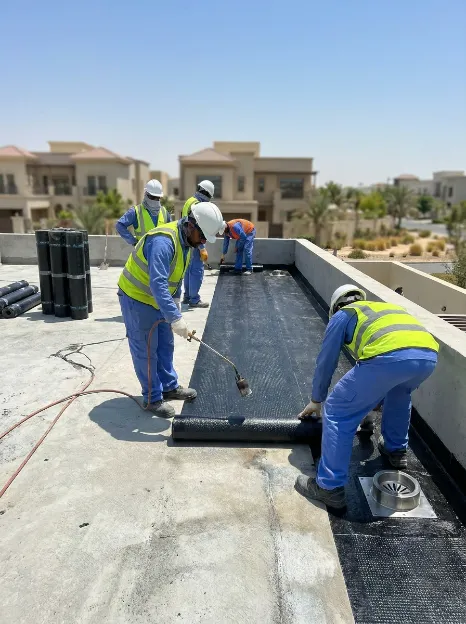
Villa, Khalifa City, 240sqm roof. Full strip-out after two failed overlays, torch-on membrane with new falls to the outlets. AED 31,500, fourteen days.
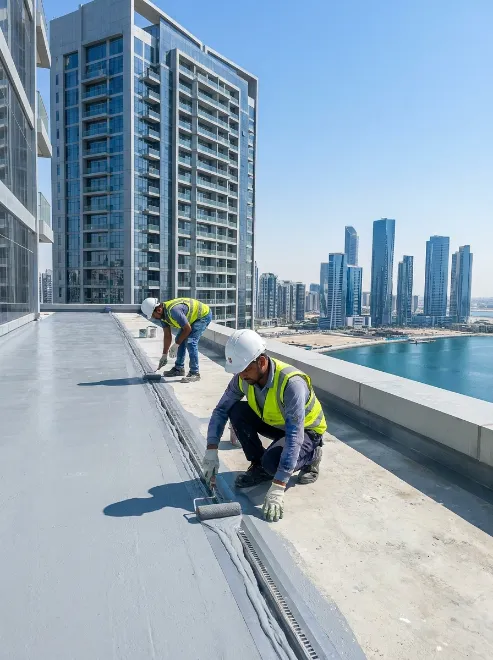
Apartment tower, Al Reem Island, podium deck. Leak into the car park below traced to failed movement joints. Liquid PU with full joint detailing and flood test. AED 86,000, twenty-two days.
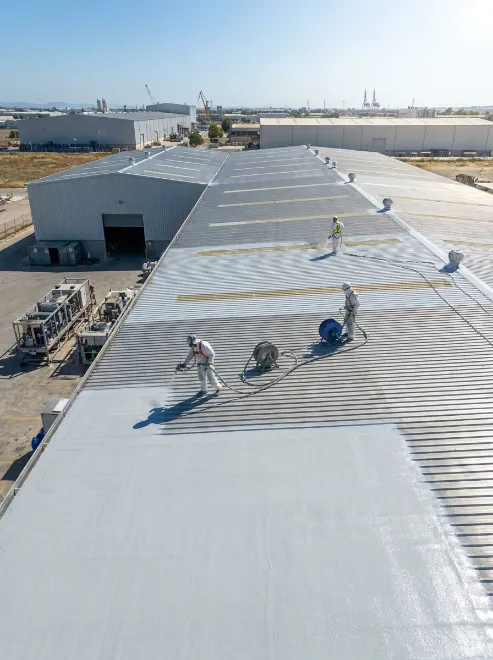
Warehouse, Mussafah, 1,400sqm roof. Polyurea overlay after core sampling confirmed a dry substrate. Phased in sections to keep operations running. AED 148,000, nineteen days.
Areas We Cover Across Abu Dhabi
Al Khalidiya
Al Bateen
Al Markaziyah
Corniche
Al Zahiyah
Tourist Club Area
Al Mushrif
Al Karamah
Al Nahyan
Yas Island
Saadiyat Island
Al Reem Island
Al Raha Beach
Al Maryah Island
Khalifa City
Al Shamkha
Masdar City
Al Reef
Mussafah
ICAD
Khalifa Industrial Zone
Mohammed Bin Zayed City
Baniyas
Shahama
Al Ain
Why Choose Dubai Technical Works for Waterproofing in Abu Dhabi
Licensed, Insured Teams and Approved Applicators
Valid trade licence, public liability cover and worker insurance, with documentation kept ready for building and municipality submissions. Our applicators are trained on the systems we install rather than treating every product as interchangeable.
Fixed Written Quotes Naming the System
The quote states the system, the manufacturer, the coverage rate, and the price, including reinstatement. If we strip a roof and find structural concrete damage nobody could see, we stop and quote that separately for approval.
Flood Tested Before Reinstatement, Photographed
Every membrane is hold tested before screed, tile or protection goes back on. You see the photos before you pay for the reinstatement stage.
Warranty up to 10 Years by System
Polyurea 10 years, torch-on membrane 10, crystalline 10, liquid PU 7, cementitious 5. The warranty covers membrane and workmanship failure. Structural movement, third-party damage, and later penetrations drilled through the system sit outside it, and we write that on the quote rather than mention it afterwards.
One Contractor for Waterproofing, Tiling, Plumbing and Reinstatement
A leaking bathroom needs waterproofing, Plumbing and Tiling. A stained ceiling needs Repainting afterwards. We handle all of it, so nobody blames the trade before them.
What Our Abu Dhabi Clients Say
Two contractors had overlaid our villa roof, and it still leaked. These guys core sampled it, showed me the wet insulation, and stripped it properly. First dry winter in four years.
Mohammed
Khalifa City
Podium deck leaking into the car park. They found it was the movement joints, not the field membrane, and sent flood test photos before letting the screeders back on.
Jennifer
Al Reem Island
Told me straight that the ceiling stain was AC condensate, not the roof. Fixed that instead and saved me a roof job I didn’t need.
Saeed
Al Mushrif
FAQs
Frequently Asked Questions About Waterproofing in Abu Dhabi
Cementitious systems run AED 45 to 90 per sqm, torch-on membrane AED 60 to 120, liquid PU AED 70 to 140, and polyurea AED 160 to 320. A bathroom costs AED 2,800 to 7,500 complete, and a 200sqm villa roof costs AED 18,000 to 38,000, including reinstatement.
A 200sqm villa roof runs AED 18,000 to 38,000 depending on the system and whether the existing layer comes off. Overlay on a sound, dry substrate saves 30% to 40% against a full strip-out. The survey confirms which applies before you commit.
A bathroom takes 6 to 8 days including cure, flood test and retiling. A villa roof takes 12 to 15 days. A basement takes 15 to 21 days, and a 1,000sqm warehouse roof takes 20 to 27 days. Add 5 to 10 working days for building or municipality approvals.
Torch-on membrane and polyurea last 15 to 20 years; liquid PU 10 to 15 years (exposed); cementitious 8 to 12 years (under tile. Lifespan drops where water ponds instead of draining, where penetrations were drilled after application, or where detailing at upstands was never done properly.
Torch-on bituminous membrane for concrete roofs under screed or ballast. Liquid PU for complex roofs with many penetrations where sheet laps become a weak point. Polyurea where downtime costs money. For newer buildings with thermal requirements, a combo insulated system handles both.
Yes, when the existing membrane is bonded, the substrate below is dry, and the roof is structurally sound. We take core samples to confirm. Overlaying a wet build-up traps the moisture, and the first hot season drives it into blisters that lift the new layer.
Thermal imaging and moisture meters map the wet zone, then flood or dye testing isolates the entry point. Water tracks laterally before it drops, so the stain is rarely under the failure. About one in four leaks we survey turns out to be plumbing or AC condensate.
Yes. It is the only proof the system works. We pond water for 48 to 72 hours with a marked level, photograph it at both ends, and inspect the space below. Covering a membrane without testing means finding failures after the finishes are down.
Yes, and it needs the right approach. Much of Abu Dhabi has groundwater close to the surface, so basements face constant hydrostatic pressure. Crystalline systems work against negative-side pressure, and below-ground membranes need protection boards and proper drainage to survive backfill.
Yes. GRP lining for concrete water tanks, sunken slabs and pools, which forms a jointless basin independent of the structure. Tanks holding potable water get food-grade compliant linings. Tank jobs run AED 9,000 to 26,000 depending on capacity and condition.
Waterproofing of roofs, wet areas, and below-ground structures falls under Abu Dhabi Municipality and DMT building requirements, and on permitted works, it must be completed before finishes go back. Towers and communities separately require contractor NOCs, which take 5 to 10 working days. We handle both submissions.
Emergency repairs, yes, scheduled for early morning. Planned work, no. Roof surface temperatures push liquid systems past their application limits, and solvent flashes off before the film levels. October through April is the proper window, and it books out from October.
Yes. Active leaks into occupied space get a surveyor within 24 to 48 hours. The first visit is containment and source identification. The permanent system goes on once the substrate is measurably dry, because applying a membrane to wet concrete guarantees you pay for the job twice.
Up to 10 years depending on system: polyurea, torch-on membrane, and crystalline at 10 years; liquid PU at 7; cementitious at 5. It covers membrane and workmanship failure. Structural movement, third-party damage, and penetrations drilled after installation are excluded, and we state that in the quote.
Book a Waterproofing Survey in Abu Dhabi Today

Dubai Technical Works provides professional technical services in Dubai and reliable handyman services in Dubai for homes and businesses. We offer AC, electrical, plumbing, painting, waterproofing, CCTV, tiling, gypsum, and property maintenance services with skilled technicians, transparent pricing, and timely solutions.
Copyright ©Dubai Technical Works Designed BY Crew Innovations