
Top-Rated Spray Painting in Dubai
Spray painting in Dubai covers doors, kitchen cabinets, wardrobes, metal railings, window frames, furniture, walls and ceilings, applied with HVLP and airless equipment. Dubai Technical Works prices start from AED 180 per interior door, sprays factory-grade 2K polyurethane for a finish with no brush or roller marks, and backs every job with a two-year written warranty.
Call +971 55 711 3252 for a fixed quote.
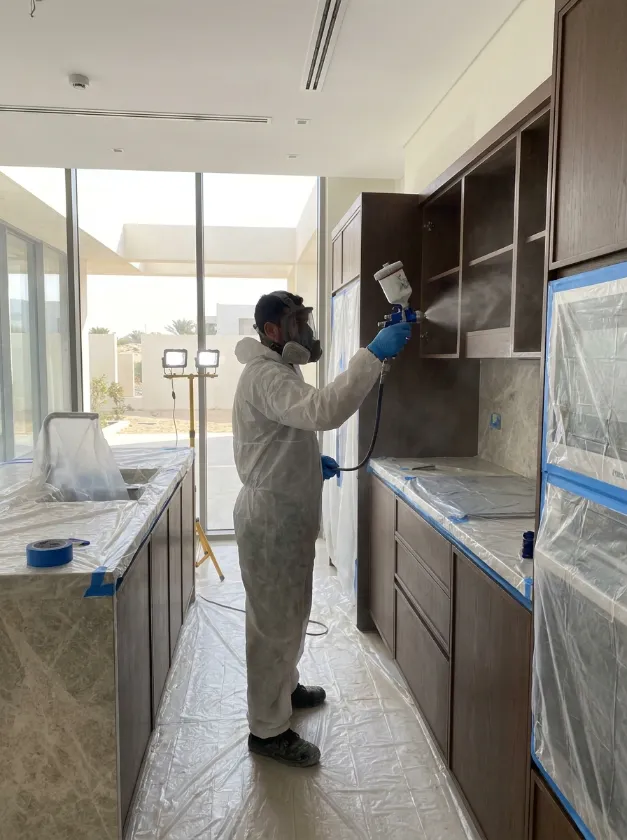
Professional Spray Painting Services Across Dubai
We spray residential, commercial and industrial surfaces across Dubai, Sharjah and the wider UAE. Villas, apartments, townhouses, offices, retail units, showrooms, restaurants and hotels.
Two ways we work. On-site spraying with full containment for fixed joinery, walls and large metalwork. Workshop spraying for removable items like cabinet doors, wardrobe fronts and furniture, which gives a cleaner finish with zero overspray risk in your home.
Our clients include homeowners refreshing tired kitchens, landlords preparing units between tenants, interior designers matching new joinery to an existing scheme, and fit-out contractors needing shopfronts and reception desks resprayed on schedule.
What We Spray in Dubai
Kitchen Cabinets and Wardrobes
Cabinet doors, drawer fronts, carcass faces and wardrobe panels in MDF, laminate, veneer or solid wood. We remove doors and spray them in the workshop, then refit. Laminate and melamine need a dedicated adhesion primer; without it, the topcoat peels off in sheets within a year, which is the single most common failure we are called to fix.
Interior and Exterior Doors
Flush doors, panel doors, louvred doors and frames. Louvres are where spraying earns its money. A brush leaves heavy build-up in every slat corner and takes four times as long. Interior doors from AED 180, exterior from AED 280.
Metal Railings, Balustrades and Steel Grills
Staircase railings, balcony balustrades, window grills and handrails in steel or wrought iron. Rust gets wire-brushed and treated before any primer goes on. Spraying over surface rust hides it for six months, then it bleeds through as orange staining. See glass railings and balustrades.
Window Frames, Aluminium and uPVC
Aluminium and uPVC frames, sills and trims. Both are low-energy surfaces that reject standard paint. They need degreasing, light keying and a specialist adhesion primer. Done properly a sprayed uPVC frame outlasts replacement cost by years. See aluminium windows.
Furniture and Joinery Refinishing
Tables, chairs, sideboards, shelving, bed frames and built-in joinery. We strip failed lacquer rather than coating over it, because old NC lacquer under a PU topcoat lifts and wrinkles. Furniture goes to the workshop and comes back in 3 to 5 days.
Walls, Ceilings and Suspended Ceiling Grids
Large wall and ceiling areas sprayed with airless equipment, including suspended ceiling tiles and grid systems in offices and retail. Spraying a ceiling grid in place is far faster than brushing around every tile edge. See false ceiling work.
Gates, Fences and Boundary Metalwork
Villa gates, boundary fences, garden railings and pedestrian gates. Exterior metal in Dubai needs an anti-corrosion primer under a UV-stable topcoat. Direct-to-metal paint straight onto bare steel chalks within two summers.
Shopfronts, Cladding and Commercial Facades
Shopfront frames, cladding panels, curtain wall sections, signage frames and retail fittings. We schedule commercial work outside trading hours and phase it so the unit stays open.
Radiators, AC Grilles and Service Equipment
Grilles, diffusers, ducting covers, exposed service pipework and plant equipment. These need heat-tolerant coatings and careful masking so nothing sprays into the duct itself.
Spray or Brush? When Spraying Is the Wrong Choice
Spraying is not always the right answer, and any painter who says otherwise is selling.
Spray wins on louvred doors, cabinet and wardrobe fronts, railings, grills, intricate joinery, and large flat metal surfaces. Anywhere a brush leaves marks or cannot reach, spraying gives a finish nothing else matches.
Brush and roller win on textured walls, small patch repairs, and single-room jobs in occupied homes where masking costs more in time than the paint costs in material. A sprayed textured wall looks identical to a rolled one and costs roughly double in preparation.
We tell you which one your job needs at the site visit. Sometimes that means quoting you a cheaper roller job.
On-Site Spraying or Workshop Spraying?
When We Spray in Your Property
Fixed joinery, built-in wardrobes, walls, ceilings, railings, gates, and anything that cannot be removed. We mask and contain the area fully, run extraction where the space allows, and work room by room.
When Items Come to Our Workshop
Cabinet doors, drawer fronts, wardrobe doors, loose furniture and door leaves. Items are labelled, transported, sprayed in controlled conditions, and refitted. You get a better finish because dust and air movement are controlled, and there is no overspray risk anywhere in your home. For a standard kitchen, the doors leave on day one and return on day four or five.
Overspray Containment, Masking and Extraction
Overspray is the whole risk in this trade. We sheet floors fully, mask glass, sockets, switches, handles, hinges, and adjacent surfaces, seal doorways with plastic screens, and isolate the AC so mist does not travel through return air into other rooms. That last point catches out most contractors, and it is how overspray ends up on a bedroom floor two rooms away.
Paint Systems and Coatings We Spray
2K Polyurethane for Cabinets, Doors and Joinery
Two-pack polyurethane cures by chemical reaction, not evaporation. It gives the hardest, most scratch-resistant finish available for kitchens and joinery, available matt through high gloss. Our default for cabinets and doors. Expect 8 to 12 years on interior joinery in normal use.
NC Lacquer for Furniture and Fast Turnaround
Nitrocellulose lacquer dries fast and sands beautifully, which makes it suited to furniture refinishing and quick turnarounds. Less chemically resistant than 2K PU, so we keep it away from kitchen fronts and anything that meets cleaning products daily.
Enamel and Direct-to-Metal for Railings and Gates
Enamel over an anti-corrosion primer for interior metalwork, direct-to-metal systems for exterior gates and fences. Flexible enough to handle thermal movement in metal that reaches 60°C in summer sun.
Epoxy and Primer Systems for Metal and Industrial Surfaces
Zinc-rich and epoxy primers for structural steel, warehouse metalwork and industrial equipment where corrosion protection matters more than appearance. Also used as a barrier coat under topcoats on problem substrates.
Emulsion and Acrylic for Walls and Ceilings
Water-based acrylic emulsion sprayed through airless equipment for walls, ceilings and large plaster or gypsum areas. Low odour, fast recoat, and far quicker than rolling across a vacant villa.
Brands We Spray
Jotun, Nippon, Caparol, Sadolin, Hempel and Sika. We name the product and system on your quote. A quote that just says “paint supplied” is hiding the grade.
Equipment: HVLP, Airless and Air-Assisted
HVLP guns atomise at low pressure with a soft spray pattern and minimal overspray, which makes them right for cabinets, doors, furniture and anything needing a fine finish.
Airless sprayers push paint at high pressure through a small tip. Fast, high coverage, ideal for walls, ceilings, large metal and exterior surfaces. Wrong for cabinet doors.
Air-assisted airless sits between the two and suits commercial joinery where both speed and finish matter.
This is why a decorator with a hired airless gun produces orange peel on your kitchen doors. The equipment was built for walls.
Surface Preparation by Material
MDF and Laminate Kitchen Cabinets
Degrease thoroughly, since kitchen fronts carry cooking grease even when they look clean. Key with 240 grit, dust off, then apply a laminate-specific adhesion primer. Raw MDF edges need sealing or they drink primer and stay rough.
Solid Wood and Veneer
Strip failed finishes rather than coating over them. Fill grain where a smooth finish is wanted, sand to 180 then 240, and prime with a wood primer that blocks tannin bleed on oak and mahogany.
Steel, Iron and Galvanised Metal
Wire-brush or abrade rust back to sound metal, treat corrosion, degrease, then apply an anti-corrosion primer. Galvanised steel needs an etch or mordant wash first, because paint will not grip bare zinc.
Aluminium and uPVC
Both are low-energy surfaces. Degrease with solvent, abrade lightly, then apply a dedicated adhesion primer. Skipping that primer is why most sprayed uPVC frames fail inside twelve months.
Walls, Gypsum and Plaster
Fill, sand, dust off, and prime. New gypsum board drinks paint unevenly without a sealer coat, which shows as patchy sheen under daylight.
Colour Matching, RAL Codes and Sheen Levels
We match to RAL and NCS codes, or scan an existing door, cabinet or frame to match new joinery to what is already in the room. Bring us a drawer front, and we will match it.
Sheen matters as much as colour. Matt hides substrate imperfections. Satin and semi-gloss wipe clean and suit kitchens and doors. High gloss looks superb and shows every flaw underneath, which is why gloss jobs cost more in preparation rather than in paint. Budget an extra sanding and filling stage if you want true high gloss.
Transparent Spray Painting Prices in Dubai (2026)
Free Site Visit and Fixed Quote
The visit takes 30 to 45 minutes. We identify substrates, count items, agree colour and sheen, confirm on-site or workshop, and issue a written fixed quote the same day.
Spray Painting Price List
Item / Scope | Price (AED) |
Interior door (both faces) | 180 – 320 |
Exterior door (both faces) | 280 – 550 |
Door frame and architrave | 90 – 180 |
Kitchen cabinets, 10–15 units | 3,500 – 6,500 |
Kitchen cabinets, 16–25 units | 6,000 – 11,000 |
Wardrobe set (per door) | 220 – 420 |
Metal railing (per linear metre) | 120 – 280 |
Window frame (per unit) | 150 – 400 |
Furniture item (chair to sideboard) | 250 – 1,500 |
Walls and ceilings (per sqm) | 18 – 35 |
Gates and fencing (per sqm) | 90 – 180 |
Commercial / shopfront (per sqm) | 55 – 140 |
Respray or Replace? The Cost Comparison
Item | Respray (AED) | Replace (AED) |
Kitchen, 18 units | 7,500 | 28,000 – 60,000 |
Six interior doors | 1,500 | 7,000 – 14,000 |
Villa staircase railing | 2,200 | 9,000 – 18,000 |
Wardrobe set, 8 doors | 2,600 | 12,000 – 25,000 |
A respray typically costs 20% to 35% of replacement. The deciding factor is substrate condition. Swollen MDF, delaminated laminate, or water-damaged carcasses are not worth spraying, and we will say so.
What Changes the Quote
Item count and size, substrate type, how much failed finish has to come off, colour direction (dark to light needs an extra coat), gloss level, on-site versus workshop, and access or masking complexity in occupied properties.
Our Spray Painting Process and Timeline

Site Visit, Colour Selection and Fixed Quote
Substrate identification, item count, colour and sheen agreed, written quote same day. 30 to 45 minutes.

Dismantling and Workshop Transfer Where Needed
Doors, fronts and handles removed, labelled by position and transported. Hinges and handles bagged per item so nothing comes back in the wrong place.

Masking, Sheeting and Containment
Floors sheeted, glass and fixtures masked, doorways screened, AC isolated. Two to four hours for a typical apartment.

Degreasing, Sanding and Substrate Repair
Degreasing, keying, filling chips and dents, edge sealing on raw MDF, rust treatment on metal. This stage decides whether the finish lasts.

Primer and Adhesion Coat
Substrate-specific primer, sanded flat once cured. Any flaw visible at primer stage will be twice as visible under gloss.

Topcoat Application in Multiple Light Passes
Two to three light coats rather than one heavy pass. Heavy coats sag and run. Light passes build an even film with no texture.

Cure, Refit and Inspection Under Daylight
Full cure, then refitting and inspection in natural daylight with you present. Spray defects only show properly in daylight, not under lamp light.
How Long Does Spray Painting Take?
Job | Prep | Spray | Cure | Refit | Total |
Single interior door | 2 hrs | 1 hr | 12–24 hrs | 1 hr | 1–2 days |
Six doors | 1 day | 4 hrs | 24 hrs | 3 hrs | 3 days |
Kitchen respray (18 units) | 1–2 days | 1 day | 2 days | 1 day | 5–6 days |
Wardrobe set (8 doors) | 1 day | 4 hrs | 24 hrs | 4 hrs | 3–4 days |
Villa railings | 1 day | 4 hrs | 24 hrs | — | 2–3 days |
One room, walls and ceiling | 4 hrs | 3 hrs | 12 hrs | — | 1–2 days |
Villa exterior metalwork | 2 days | 1 day | 2 days | — | 5 days |
Cure Times — When Can You Actually Use It?
Touch-dry, handling-dry, and fully cured are three different things, and confusing them ruins finished work.
2K polyurethane is touch-dry in about 2 hours, safe to handle and refit at 12 to 24 hours, and fully hardened at 5 to 7 days. NC lacquer is faster to handle but reaches full hardness in a similar window. Water-based emulsion on walls is touch-dry in an hour and cured within a week.
Load a freshly sprayed kitchen with crockery on day two, and you will press permanent marks into the finish. Wait the full week before heavy use, and avoid cleaning products entirely for the first seven days.
Dust, Heat and Humidity — Getting a Clean Finish in Dubai
Why Dust Is the Number One Defect Here
Airborne dust settling into wet paint is the defining spray problem in this market. A single dust nib ruins an otherwise perfect gloss panel. We damp down work areas, filter the air where we can, and spray gloss and fine-finish work in the workshop rather than on site. Any contractor spraying your kitchen doors in your living room is accepting dust into the finish.
Temperature, Humidity and Flash-Off
In summer heat, solvent flashes off before the paint levels, giving dry spray and a rough texture. We spray early morning for exterior work between May and September, or move the work indoors. High humidity causes blushing in lacquer, visible as a milky haze.
Coastal Properties and Metal Corrosion
Metalwork in Dubai Marina, JBR, Palm Jumeirah and Jumeirah takes salt-laden air that attacks steel at every coating breach. Exterior metal in these communities needs a zinc-rich or anti-corrosion primer and realistically a recoat every 4 to 5 years rather than 7.
Common Spray Finish Defects and What Causes Them
- Orange peel — wrong gun or tip, paint too thick, pressure too low.
- Runs and sags — coat applied too heavily in one pass.
- Dry spray — gun held too far back, or solvent flashing off in heat before the paint levels.
- Fisheyes — silicone or grease contamination from inadequate degreasing.
- Blushing — spraying lacquer in high humidity.
- Dust nibs — uncontrolled environment, no damping down, no filtration.
- Peeling — wrong primer for the substrate, or no primer at all.
Spraying in Occupied Homes and Towers
Fumes, Ventilation and Re-Occupancy Timing
Water-based systems on walls clear in 6 to 12 hours with ventilation and AC running. Solvent-based 2K and lacquer need stronger ventilation and are better suited to the workshop. For occupied apartments, we spray water-based on site and take everything solvent-based away.
Building NOCs and Tower Restrictions on Spraying
Most Dubai towers require a contractor NOC before work starts: trade licence copy, insurance certificates, worker Emirates ID, a refundable deposit of AED 1,000 to 5,000, and a booked service lift. Contractor hours typically run 9 am to 6 pm on weekdays. Many buildings refuse solvent spraying indoors entirely, which is exactly why we offer workshop spraying. Approval takes 2 to 5 working days, and we handle the submission.
Protecting Floors, Glass, Fixtures and Electronics
Full floor sheeting, masked glass and mirrors, covered electronics, sealed doorways, bagged handles and hinges, and isolated AC return air. We photograph the protection before spraying so there is no dispute afterwards.
Recent Spray Painting Projects in Dubai
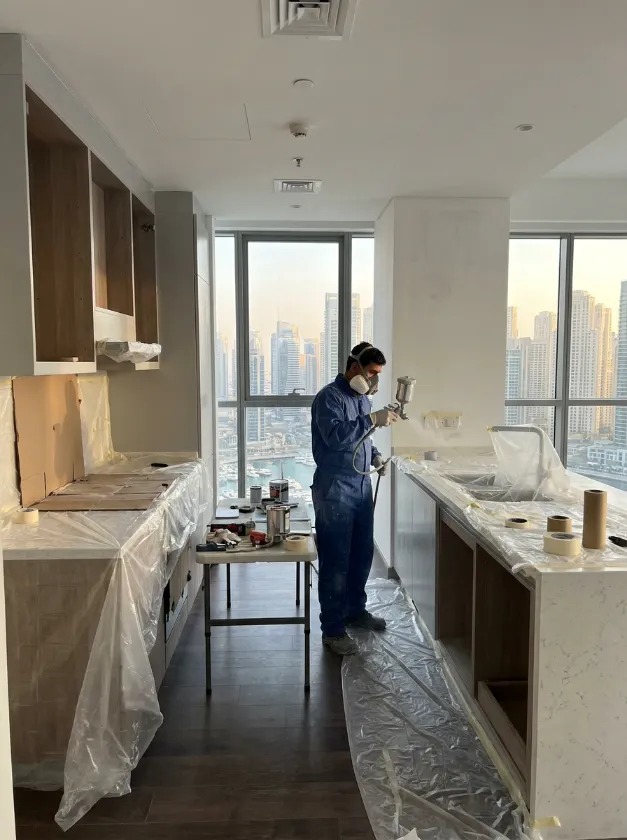
Apartment, Dubai Marina, kitchen respray. 16 units in 2K PU satin, doors sprayed in workshop, carcasses on site. AED 6,800, five days.
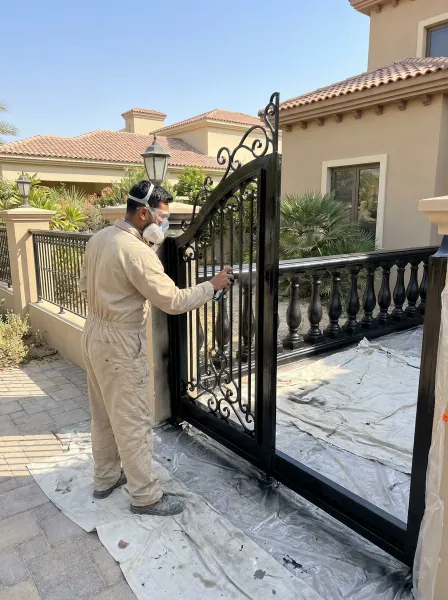
Villa, Arabian Ranches, staircase railing and gates. Rust treatment, anti-corrosion primer, enamel topcoat. AED 4,600, four days.
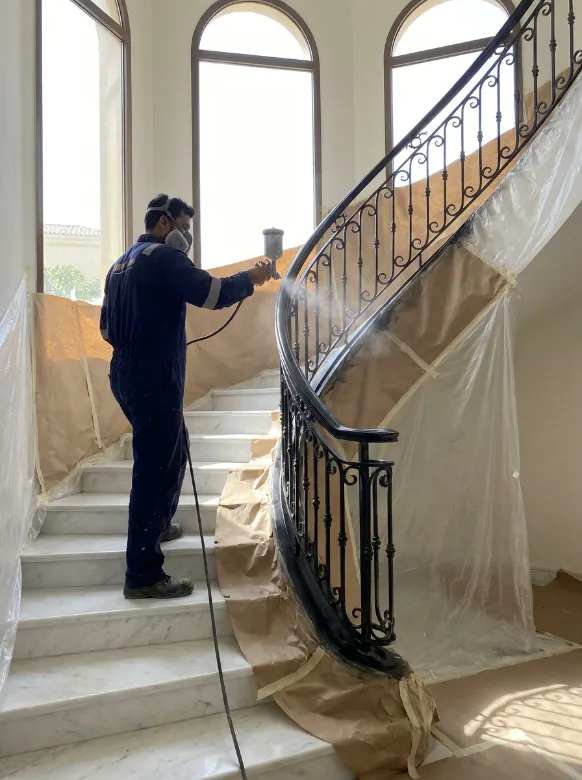
Retail unit, Al Quoz, shopfront and fittings. Shopfront frame, display fittings and reception desk resprayed overnight across three nights. AED 9,200, three nights.
Areas We Cover Across Dubai
Business Bay
Downtown
DIFC
JLT
Jumeirah
Umm Suqeim
Emirates Hills
Palm Jumeirah
Arabian Ranches
Dubai Hills Estate
Al Barsha
Dubai Marina
Al Quoz
DIP
Jebel Ali
Industrial Zones
Dubai Silicon Oasis
Dubai South
Deira
Bur Dubai
Abu Dhabi
Sharjah
Ajman
Why Choose Dubai Technical Works for Spray Painting
Licensed, Insured Teams and Safe Solvent Handling
Valid Dubai trade licence, public liability cover and worker insurance, with documentation kept NOC-ready for tower submissions. Our sprayers work with proper respiratory protection and extraction, which matters when solvent-based systems are involved.
Fixed Written Quotes with No Variations
The quote names the product, the system, and the item count. If we strip a surface and find damage nobody could see, we stop and quote the repair separately for your approval.
Two-Year Written Warranty on Sprayed Finishes
Two years covering peeling, blistering, flaking, and adhesion failure. Normal wear, impact damage, and finishes damaged by abrasive or solvent cleaners within the cure period sit outside it, and we tell you that at the quote stage.
Workshop Spraying for a Factory-Grade Finish
Controlled conditions, no site dust, no overspray in your home, and a finish that holds up to inspection in daylight. For kitchens and gloss work, it is the only sensible way to do it.
One Contractor for Spraying, Joinery, Glass and Ceilings
Kitchen resprays often need a hinge replaced or a panel repaired. We handle painting, aluminium and glass, and gypsum and false ceiling work in-house.
Customer Reviews
Quoted AED 7,000 to respray the kitchen against AED 40,000 for a new one. They took the doors away, brought them back on day four, and it looks like a new kitchen.
Nadia
Dubai Marina
Second company to try our uPVC frames. The first lot peeled in a year. These guys explained the adhesion primer, and two summers later it’s still perfect.
Graham
Arabian Ranches
Resprayed our shopfront and fittings over three nights so we never closed. Protection was taped up properly, and the place was spotless each morning.
Yousef
Al Quoz
FAQs
Frequently Asked Questions About Spray Painting in Dubai
Interior doors cost AED 180 to 320 each, exterior doors AED 280 to 550. Metal railings run AED 120 to 280 per linear metre, walls and ceilings AED 18 to 35 per sqm, and furniture items AED 250 to 1,500 depending on size. Kitchen cabinet resprays start around AED 3,500.
A 10 to 15-unit kitchen costs AED 3,500 to 6,500, and a 16- to 25-unit kitchen AED 6,000 to 11,000 in 2K polyurethane. That covers removal, degreasing, adhesion primer, workshop spraying, and refitting. Compare with AED 28,000 to 60,000 for a replacement kitchen of the same size.
For cabinets, louvred doors, railings, grills and intricate joinery, yes. Spraying leaves no brush or roller marks and reaches detail a brush cannot. For textured walls, small patches and single-room occupied jobs, rolling is faster and cheaper, because masking costs more time than the finish gains.
Wood, MDF, laminate, veneer, plywood, steel, iron, galvanised metal, aluminium, uPVC, plaster, gypsum board, concrete and most rigid plastics. Each needs its own primer. Laminate, uPVC and galvanised steel are the three that fail most often when the wrong primer is used.
A single door takes 1 to 2 days including cure. Six doors take about 3 days. A kitchen respray of 18 units runs 5 to 6 days from collection to refit. One room of walls and ceilings takes 1 to 2 days. Villa exterior metalwork takes around 5 days.
Doors are refitted in 12 to 24 hours and safe for light use immediately. Full cure takes 5 to 7 days. Load shelves heavily before then and you will press permanent marks into the finish. Avoid all cleaning products on the surface for the first week.
Not with proper containment. We sheet floors fully, mask glass and fixtures, screen doorways, and isolate the AC so mist cannot travel through return air into other rooms. For the highest-risk items like kitchen and wardrobe doors, we remove and spray them in the workshop instead.
Yes. We use water-based systems on site for walls and fixed joinery, which clear odour in 6 to 12 hours with ventilation. Anything solvent-based goes to the workshop. We work room by room so you keep a usable bedroom and bathroom throughout.
Most Dubai towers require a contractor NOC: trade licence, insurance, worker Emirates ID, a refundable deposit of AED 1,000 to 5,000, and a booked service lift. Many buildings refuse solvent spraying indoors altogether. Approval takes 2 to 5 working days, and we submit the package for you.
Yes, by RAL or NCS code, or by scanning a sample. Bring us a drawer front, a door offcut or a frame section, and we match colour and sheen to it. Matching new joinery to existing cabinetry is one of the most common requests we handle.
Interior 2K polyurethane on cabinets and doors lasts 8 to 12 years in normal use. Exterior metalwork with anti-corrosion primer lasts 5 to 7 years inland. Coastal properties in Marina, JBR and Palm Jumeirah need a recoat every 4 to 5 years because of salt exposure.
Yes, and done correctly, it lasts. Both are low-energy surfaces, so they need solvent degreasing, light abrasion, and a dedicated adhesion primer before the topcoat. Skipping that primer is why most sprayed uPVC fails within twelve months. Frames cost AED 150 to 400 per unit.
Respraying costs 20% to 35% of replacement. An 18-unit kitchen respray costs around AED 7,500, compared with AED 28,000 to 60,000 for new. Replacement wins only when carcasses are water-damaged, laminate is delaminating, or MDF has swollen, since those substrates will not hold a finish.
We offer a two-year written warranty covering peeling, blistering, flaking, and adhesion failure on the surfaces we spray. We exclude impact damage, normal wear, and damage from abrasive or solvent cleaners during the 7-day cure period. We state the exclusions on the quote rather than afterwards.
Book Spray Painting in Dubai Today
Tell us what you want sprayed, the material it’s made from, and your location. We will visit, confirm the system, and send a fixed written quote the same day.

Dubai Technical Works provides professional technical services in Dubai and reliable handyman services in Dubai for homes and businesses. We offer AC, electrical, plumbing, painting, waterproofing, CCTV, tiling, gypsum, and property maintenance services with skilled technicians, transparent pricing, and timely solutions.
Copyright ©Dubai Technical Works Designed BY Crew Innovations