Professional Demolition Contractors in Dubai & Abu Dhabi
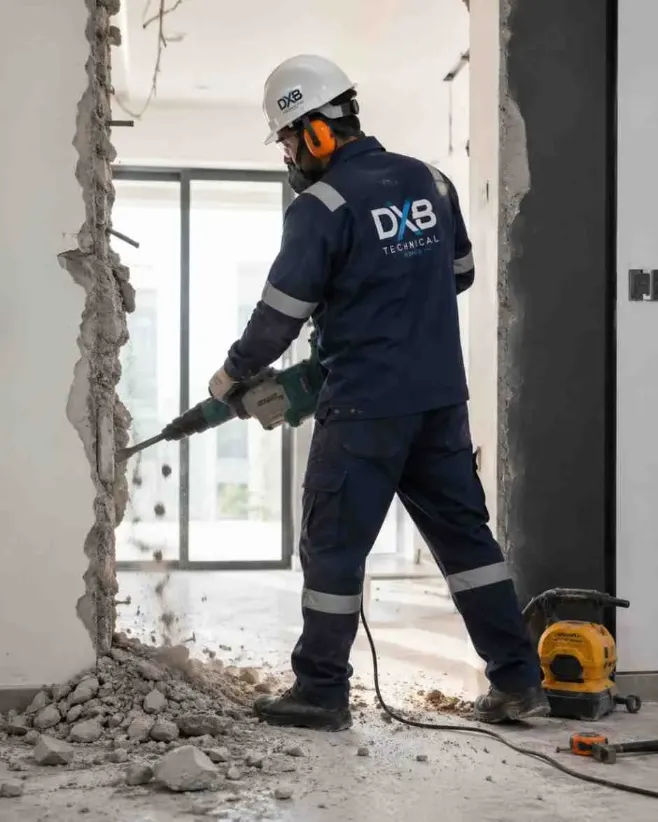
Professional demolition rarely starts with breaking concrete immediately. Depending on the building type, contractors may first carry out precision concrete cutting to remove slabs, beams, walls, staircases, or structural sections individually. This controlled approach improves safety, protects nearby structures, and reduces unnecessary dust, vibration, and noise throughout the demolition process.
Comprehensive Demolition Services in Dubai & Abu Dhabi
From wrecking and demolition works in Dubai to precision strip-outs, demolition is never a single service applied uniformly to every structure. A villa in Jumeirah requires a fundamentally different approach than a warehouse in Dubai Industrial City. A retail unit in Dubai Mall demands techniques that a factory in Al Quoz does not. Understanding these distinctions is what separates professional building demolition contractors from operators who simply bring machines to site.
Residential Demolition
Residential demolition across Dubai and Abu Dhabi covers everything from single villas to multi-storey apartment buildings. Each project type presents its own set of requirements.
Villa Demolition
Villa demolition forms a significant portion of residential work in the UAE. Older communities like Al Barsha, Mirdif, Jumeirah 1, 2, and 3, and Umm Suqeim contain villas built twenty to thirty years ago. Property owners often choose demolition and rebuild over renovation when structural assessments reveal foundation issues, when the cost of modernisation exceeds new-build economics, or when plot utilisation can be significantly improved.
A villa demolition in Arabian Ranches operates under different constraints than one on the Palm Jumeirah. In Arabian Ranches, community management enforces strict working hours and access routes. On the Palm, proximity to neighbouring villas, often just a few metres away, demands controlled, section-by-section dismantling rather than wholesale mechanical demolition. The same applies in Emirates Hills, where high-value properties sit on interconnected plots, making vibration monitoring and dust suppression non-negotiable.
House and Low-Rise Residential Building Demolition
When a residential building in Bur Dubai, Deira, or Al Nahda reaches the end of its serviceable life, demolition becomes a carefully managed process. These areas feature high population density and narrow access roads. Site teams must coordinate with Dubai Municipality for temporary road occupancy permits, manage utility disconnections through DEWA, and maintain continuous communication with adjacent residents and businesses.
The practical reality is that low-rise residential demolition in established Dubai neighbourhoods happens in confined spaces. A 60-tonne high-reach excavator will not fit down the alley behind a building in Al Karama. This is where manual dismantling, smaller robotic demolition units, and sequenced structural removal come into play.
Commercial & Industrial Demolition
Commercial demolition in the UAE operates at a different scale entirely. Office towers, shopping malls, hotels, and industrial facilities bring complexities that demand engineering-led approaches rather than straightforward machine work.
Office and Retail Demolition
Consider an office fit-out demolition in Business Bay versus a full structural demolition of a retail unit in a community shopping centre. The Business Bay project likely involves strip-out of interior partitions, removal of suspended ceilings, MEP decommissioning, and preparation for a new tenant’s fit-out, all while neighbouring offices continue operations on floors above and below. Noise transfer through concrete slabs becomes a primary concern. Acoustic monitoring and out-of-hours work scheduling are standard practice.
Retail demolition inside operational malls like Mall of the Emirates or Dubai Mall adds another layer: fire alarm system isolation, temporary hoarding that meets mall brand standards, and logistics planning that avoids service corridors during delivery hours. These are the practical details that site teams manage daily.
Hotel, School, and Hospital Demolition
Institutional buildings present unique challenges. Hotels along Sheikh Zayed Road or in Dubai Marina must be stripped out and demolished while protecting adjacent hotel operations. Schools require demolition scheduling during holiday periods. Hospital demolition, or more commonly, phased decommissioning and demolition within active medical campuses, demands hospital-grade infection control barriers, negative air pressure containment, and absolute vibration limits to protect sensitive medical equipment in nearby wards.
Warehouse, Factory, and Industrial Demolition
Industrial demolition and dismantling works in Dubai cover steel-framed warehouses, reinforced concrete factories, and processing plants across Dubai Industrial City, Jebel Ali Industrial Area, and Al Quoz. These structures often contain residual industrial materials, embedded machinery foundations, underground storage tanks, and chemical residue. Pre-demolition environmental surveys are not optional. They are a municipal requirement.
Steel structure dismantling in warehouse demolition is typically sequenced to preserve salvage value. Structural steel from pre-engineered buildings holds significant scrap recovery value. An experienced demolition company in Dubai will factor material recovery credits into the project cost estimate, reducing the overall financial burden on the client.
High-Rise Demolition
High-rise demolition in Dubai and Abu Dhabi is an engineering discipline in its own right. Buildings exceeding 12 storeys require sequenced dismantling using high-reach excavators positioned on purpose-built platforms, or in specific cases, controlled collapse techniques that demand exclusion zone modelling, seismic monitoring, and multi-agency coordination.
Specialty Demolition Services
Beyond building demolition, several specialised services form part of a complete demolition contractor’s capabilities.
Concrete Cutting and Controlled Demolition
Concrete cutting encompasses wall sawing, floor sawing, wire sawing, diamond cutting, and core drilling. These techniques enable precision removal of structural elements without transmitting vibration through the remaining structure. When a building in Downtown Dubai requires a new elevator shaft through existing slabs, wire sawing cuts clean openings without micro-cracking the surrounding concrete. Core drilling through 400mm reinforced slabs creates precise openings for MEP services. These are not rough demolition methods, they are surgical procedures applied to concrete.
Robotic Demolition
Remote-controlled demolition robots weighing 1.5 to 5 tonnes work inside structures where human access is unsafe or impractical. Equipped with hydraulic breakers, crushers, or shears, these machines operate on partially demolished floors, inside confined basements, or in areas where structural stability is compromised. The operator stands at a safe distance, controlling the machine via line-of-sight remote. Robotic demolition has become standard practice in Dubai for selective interior demolition and basement removal.
Asbestos Removal and Hazardous Material Handling
Buildings constructed in the UAE before the asbestos ban require mandatory asbestos surveys before demolition permits are issued. A licensed demolition contractor in Dubai must either hold in-house asbestos removal capability or engage an approved hazardous materials specialist. This is not an area for shortcuts. Dubai Municipality enforces strict chain-of-custody documentation for asbestos waste, from removal and sealed containment through to licensed disposal.
Concrete Scanning (GPR)
Before any saw cutting or core drilling begins, ground-penetrating radar (GPR) scanning maps embedded utilities, post-tension cables, and rebar patterns within concrete slabs and walls. Hitting a tensioned cable during drilling can cause catastrophic structural failure. Professional demolition contractors in Dubai integrate GPR scanning as a mandatory step, not an optional extra.
Strip Out and Decommissioning
Interior strip out, also called soft strip demolition, involves the removal of non-structural elements: partitions, ceilings, flooring, MEP fixtures, doors, glazing, and built-in furniture. This typically precedes structural demolition and is done manually. Decommissioning goes further, covering the safe isolation and removal of mechanical, electrical, and plumbing systems, data infrastructure, and specialist equipment. Office buildings in DIFC or commercial towers in Abu Dhabi’s Al Maryah Island undergoing refurbishment require comprehensive decommissioning before new fit-out begins.
Excavation, Compaction, and Site Clearance
Once a structure is demolished, the work is not finished. Foundation removal, basement backfilling, excavation to new formation levels, and compaction testing prepare the site for its next phase. A site cleared for redevelopment in Dubai South or Al Khawaneej must be delivered level, compacted to specified density, and free of debris below grade. These final steps determine whether construction can proceed without delay.
Why Hire Professional Demolition Contractors?
Property owners sometimes ask whether demolition is simply a matter of bringing machines to site. The short answer is no. The longer answer involves regulations, safety protocols, environmental compliance, and the very real consequences of getting any of these wrong.
Regulations & Permits
Demolition in Dubai and Abu Dhabi operates within a structured regulatory framework. In Dubai, demolition permits are issued by the Building Department of Dubai Municipality. The process requires:
A demolition application submitted by a municipality-registered contractor
Structural assessment and demolition methodology statement prepared by a qualified engineer
Utility disconnection confirmation from DEWA (electricity and water), and clearance from Etisalat or du for telecom services
NOC from Dubai Civil Defence where fire safety systems are being decommissioned
Additional approvals from community developers—Emaar, Nakheel, Dubai Properties, Meraas, and others—depending on the project location
For properties in free zones and special jurisdictions, permits flow through Dubai Development Authority (DDA), Trakhees (for ports, customs, and Jebel Ali Free Zone), or other relevant authorities
Abu Dhabi follows a parallel process through the Department of Municipalities and Transport (DMT), with additional coordination for projects on Abu Dhabi Island, in Mussafah industrial zones, or within ADNOC-controlled areas.
The practical implication for property owners is straightforward: engaging a demolition company in Dubai that lacks current municipal registration means your permit application will not be processed. This is not a bureaucratic formality. It is the mechanism that ensures demolition work meets structural safety, environmental, and community protection standards.
Safety & Environmental Compliance
Professional demolition contractors in the UAE operate under strict health, safety, and environmental obligations. A competent contractor arrives on site with:
Project-specific risk assessments and method statements approved by qualified engineers
Documented safe work procedures covering each phase of demolition
Site-specific safety plans including exclusion zones, temporary fencing, signage, and traffic management
Dust suppression systems—water misting cannons, hose-fed spray systems, or chemical suppressants for larger projects
Noise and vibration monitoring equipment with real-time data logging
Emergency response plans coordinated with local civil defence authorities
Worker welfare provisions meeting UAE labour law requirements
Environmental compliance extends beyond dust and noise. Construction and demolition waste in Dubai must be transported by approved waste haulers to licensed facilities. Dubai Municipality’s Waste Management Department regulates this chain strictly. Demolition contractors who cut corners on waste disposal face significant penalties, and more importantly, expose their clients to legal liability.
Our Demolition Process
Demolition follows a defined sequence. Projects that deviate from this sequence—or skip steps—are the ones that encounter problems. Here is how professional demolition work is structured from start to finish.
Site Inspection & Planning
The process begins well before any machinery arrives. A senior engineer and project manager visit the site to conduct a detailed assessment. They examine:
Structural type, condition, and construction methodology
Adjacent structures and their proximity to the demolition zone
Site access routes, including road width, overhead obstructions, and turning radii for heavy vehicles
Presence of hazardous materials requiring specialist surveys
Utility connections and isolation points
Any heritage, environmental, or community constraints
This inspection informs the engineering methodology. A villa demolition in Al Warqa will not use the same approach as a warehouse demolition in Al Quoz, and neither will resemble a selective interior strip-out in JLT. The methodology statement becomes the controlling document for everything that follows.
Permitting & Preparation
With the methodology approved, the permitting process begins. Utility disconnection applications go to DEWA, Etisalat, and du simultaneously to avoid sequential delays. Community NOCs are sought where applicable. The site preparation phase includes:
Installation of site hoarding and pedestrian protection
Utility isolation and temporary service provisions if required
Asbestos survey and removal if the building pre-dates the ban
Structural propping or temporary supports if partial retention is required
Setting up dust suppression, wheel washing, and site welfare facilities
Safe Execution
Demolition execution follows the approved sequence. For mechanical demolition, machines position at calculated distances and working angles. For manual dismantling, teams work from top-down, floor-by-floor, with continuous structural monitoring. No floor is overloaded with debris. No structural element is removed before the load path is understood.
A demolition supervisor is present throughout active operations. The project manager conducts daily briefings and inspections. The safety officer maintains continuous monitoring of dust, noise, and vibration levels. Any deviation from expected readings triggers immediate review.
Debris Removal & Recycling
Debris management is integral to the demolition timeline. Concrete is segregated from steel, timber, and general waste on site. Concrete is crushed to specified gradations for reuse as fill material or sent to recycling facilities. Structural steel is cut to transportable lengths and delivered to scrap processing yards. General waste goes to licensed municipal facilities. Hazardous materials follow separate, documented disposal chains.
The goal is not merely to clear the site. It is to maximise material recovery and minimise landfill burden. This approach aligns with UAE sustainability objectives and, where applicable, contributes to green building certification credits for the redevelopment project that follows.
Service Areas
Demolition in Dubai
We deliver demolition works across the UAE, covering all Dubai municipalities and communities. Our operational footprint covers:
Dubai Marina
Downtown Dubai
Business Bay
Palm Jumeirah
Jumeirah
Al Barsha
Dubai Hills Estate
Arabian Ranches
Emirates Hills
JVC
JLT
Al Quoz
Mirdif
Silicon Oasis
International City
Deira
Bur Dubai
DIP
Dubai South
The Springs
The Meadows
Damac Hills
Town Square
Bluewaters Island
Dubai Creek Harbour
Sharjah
Ajman
Abu Dhabi
Demolition in Abu Dhabi
Our operations extend to Abu Dhabi emirate, covering Abu Dhabi Island, Mussafah Industrial Area, Mohammed Bin Zayed City, Khalifa City, Al Raha, Al Reem Island, and Saadiyat Island. We hold the necessary registrations to work within Abu Dhabi municipality jurisdiction and coordinate with DMT, ADDC, and relevant authorities for permits and utility management.
Why Choose Dubai Technical Works for Demolition
Choosing among demolition companies in Dubai is a decision with financial, legal, and timeline implications.Here are the factors that matter when evaluating contractors:
Municipality Registration and Licensing
We hold current Dubai Municipality classification as demolition contractors. This is not a marketing claim, it is a verifiable credential checked during the permit application process. Without it, demolition permits cannot be issued.
Engineering Capability
Our project delivery team includes structural engineers, civil engineers, and HSE professionals. Demolition methodology statements are prepared and approved by qualified engineers, not drafted as generic templates.
Specialised Equipment Fleet
We own and operate the equipment required for demolition across all scales. This includes high-reach excavators for tall structure demolition, standard hydraulic excavators with breaker and crusher attachments, demolition robots for confined-space work, diamond cutting and core drilling equipment, and GPR concrete scanning units. Equipment ownership, rather than relying entirely on hired machines—means faster mobilisation and better cost control.
ISO-Certified Management Systems
Our operations are governed by integrated management systems certified to ISO 9001 (Quality Management), ISO 14001 (Environmental Management), and ISO 45001 (Occupational Health and Safety). These standards provide independently verified assurance that our processes meet international benchmarks.
Comprehensive Insurance
We carry full insurance coverage including public liability, contractor's all-risk, and worker compensation. Clients receive documented evidence of coverage before project commencement.
Case Studies & Past Projects
We have completed demolition projects across villa communities, commercial districts, and industrial zones in Dubai and Abu Dhabi. Our portfolio includes:
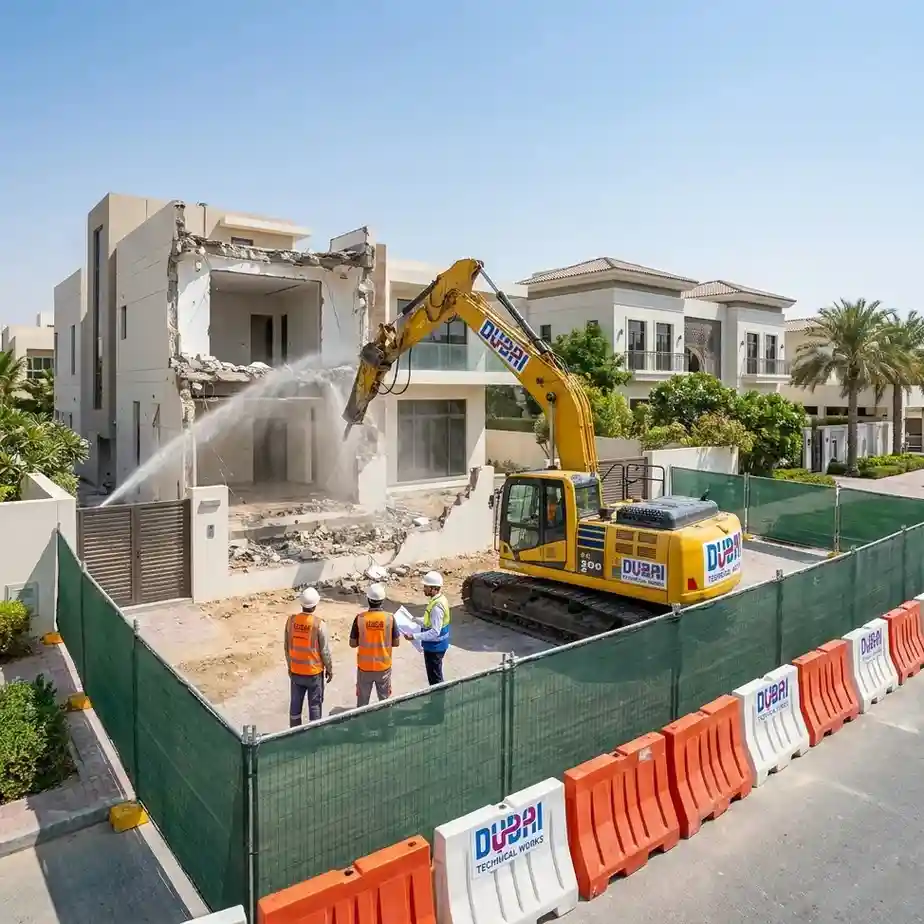
Villa demolition programmes in Jumeirah and Al Barsha for private owners and developers
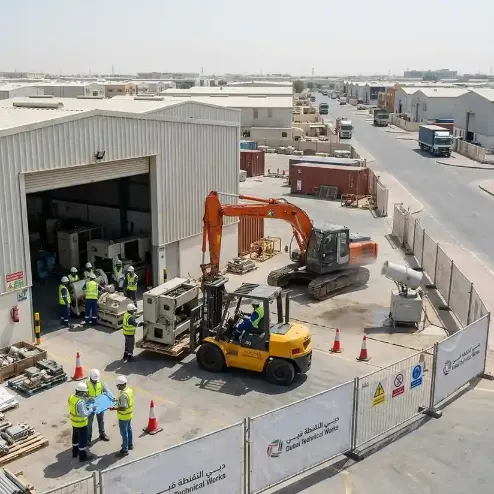
Warehouse and factory decommissioning in Al Quoz and Dubai Industrial City
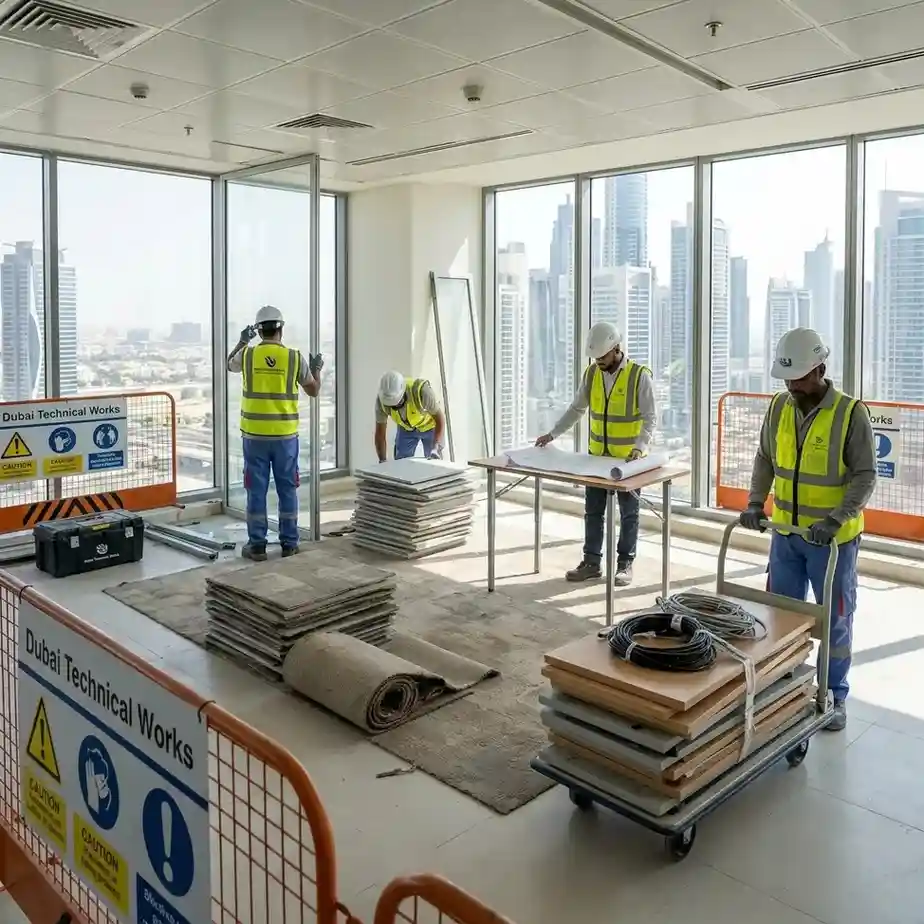
Office floor strip-out and decommissioning in Business Bay commercial towers
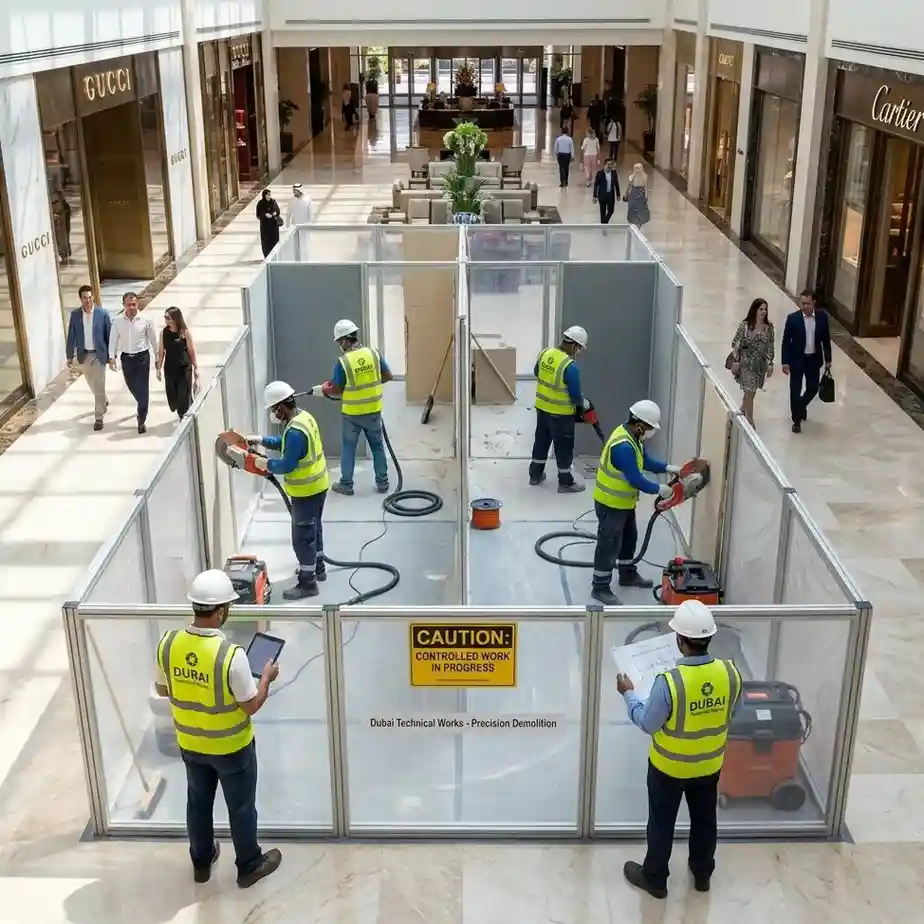
Controlled interior demolition in occupied hotel and retail environments
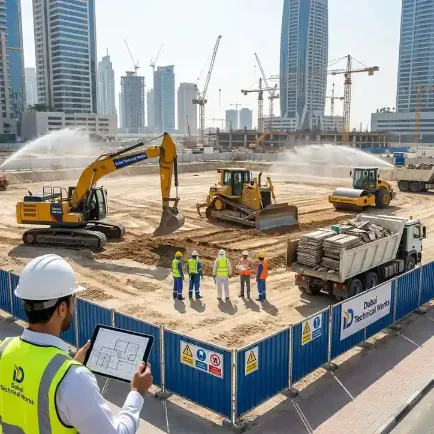
Complete site clearance and ground preparation for redevelopment projects
FAQs
Frequently Asked Questions
In Dubai, you need a demolition permit from Dubai Municipality's Building Department, utility disconnection confirmations from DEWA and Etisalat/du, and Civil Defence NOC where applicable. Community developer approvals are required for properties within master-planned communities. In Abu Dhabi, the Department of Municipalities and Transport issues demolition permits with similar utility clearance requirements. A registered demolition contractor handles this entire process on the client's behalf.
Demolition costs vary significantly based on structural type, building size, location, access conditions, and hazardous material presence. A standard villa demolition in a community with good access will cost differently than a multi-storey building demolition on a confined plot in Bur Dubai. We provide accurate quotations after an engineer's site inspection—never before seeing the project.
Yes. We hold current registration with Dubai Municipality as classified demolition contractors and maintain all required trade licences and insurances for demolition operations in Dubai and Abu Dhabi.
Yes. We manage hazardous material surveys and removal as part of our demolition service. For pre-ban buildings, an asbestos survey is a mandatory step in the permitting process. We handle this through qualified specialists with full chain-of-custody documentation.
Our services cover villa demolition, residential building demolition, commercial and retail demolition, industrial demolition, warehouse demolition, interior strip-out, structural decommissioning, concrete cutting and core drilling, robotic demolition, and full site clearance. We handle both complete demolition and selective structural removal.
In Dubai, we cover all major communities and industrial zones including Al Quoz, Jebel Ali, DIP, Business Bay, Downtown, Dubai Marina, Palm Jumeirah, Jumeirah, Al Barsha, Mirdif, Arabian Ranches, Dubai Hills, Deira, Bur Dubai, Dubai Silicon Oasis, Dubai South, and more. In Abu Dhabi, we serve the island, Mussafah, Khalifa City, Al Raha, Al Reem Island, and Saadiyat Island.
Project duration depends on structure size, demolition method, access constraints, and permitting timelines. A single villa demolition with good access typically completes within one to two weeks including foundation removal and site clearance. Larger commercial or industrial demolitions require detailed scheduling which we provide as part of the project plan.
Our safety protocols include project-specific risk assessments and method statements, continuous dust and noise monitoring, exclusion zone management, temporary fencing and pedestrian protection, daily toolbox briefings, emergency response planning, and full PPE compliance. We operate under ISO 45001 certified safety management systems.
Demolition involves structural engineering, heavy machinery operation, hazardous material handling, and regulated waste disposal. Attempting it without professional capability creates serious personal safety risks, potential damage to neighbouring properties, legal liability from unpermitted work, and improper waste disposal consequences. Professional demolition is not an expense—it is risk management for your property and your liability.
Yes. We segregate concrete, steel, timber, and general waste on site. Concrete is crushed for reuse or sent to recycling facilities. Structural steel and metals are recovered and delivered to scrap processing. Our waste management practices align with UAE sustainability objectives and Dubai Municipality requirements for construction and demolition waste diversion.
Get Your Free Quote Today
Every demolition project starts with a site visit. Without seeing the structure, access conditions, and constraints in person, any estimate is just a guess. We provide a comprehensive quotation based on an engineer-led site assessment, covering:
Demolition methodology tailored to your specific structure
Project timeline with key milestones
Itemised cost estimate with no hidden charges
Waste management and recycling plan
Permit application support and timeline
Contact us to schedule your free site inspection and quotation. We respond within 24 hours and can mobilise site teams quickly for urgent projects.
For a free site inspection and no-obligation quotation, contact Dubai Technical Works today. Our engineers are available to discuss your project and provide a clear, detailed assessment of what your demolition will involve, how long it will take, and exactly what it will cost.
Dubai Technical Works provides professional technical services in Dubai and reliable handyman services in Dubai for homes and businesses. We offer AC, electrical, plumbing, painting, waterproofing, CCTV, tiling, gypsum, and property maintenance services with skilled technicians, transparent pricing, and timely solutions.
Copyright ©Dubai Technical Works Designed BY Crew Innovations