
Professional Basement Waterproofing in Dubai
Basement waterproofing in Dubai protects below-ground structures from groundwater seepage, hydrostatic pressure, and construction joint failure using tanking, injection grouting, membrane systems, and cavity drainage. Dubai Technical Works surveys, diagnoses, and waterproofs villa basements, car parks, podium decks, lift pits, and retaining walls across Dubai, with written system specifications and water-tested handover.
Free site survey. Fixed quotes. Written warranty on every system we install.
Call +971 55 711 3252 or WhatsApp us to book a survey.
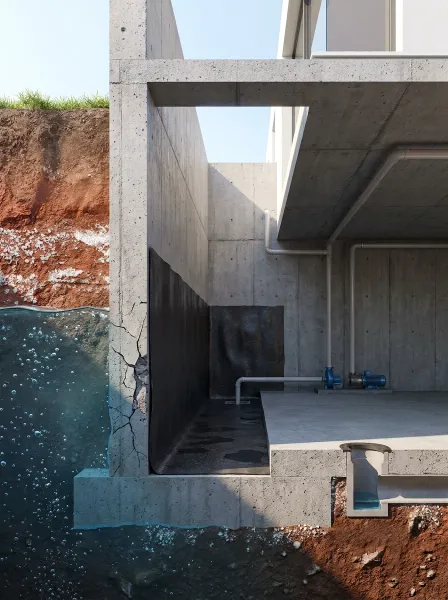
Why Dubai Basements Leak — Groundwater, Salinity & Pressure
Most basement leaks in Dubai are not from rain. They're groundwater, and the distinction matters because it changes the entire specification.
The water table sits high across much of Dubai, particularly in coastal and reclaimed areas like Dubai Marina, Palm Jumeirah, JBR and Business Bay. Any slab or retaining wall below that level faces constant hydrostatic pressure, pushing water through the smallest flaw in the concrete 365 days a year. That’s why a basement can be bone dry for three years, then start seeping with no rain anywhere in the forecast.
Groundwater here is saline. Chlorides and sulphates attack reinforced concrete from inside. Chloride penetration corrodes rebar, which expands and cracks the surrounding concrete, opening new paths for water. Sulphates attack the cement matrix itself. This is why coating a Dubai basement without addressing concrete condition fails faster than the same job in a temperate climate.
Construction joints are the usual entry point. The junction between slab and wall, around pipe penetrations and at pour breaks, is where waterstops were either never installed or damaged during pouring. We trace most villa and car park leaks back to these joints rather than through the concrete body.
Add occasional heavy rainfall events, which Dubai now sees more of, and surface water loading a drainage system that was never designed for it.
Signs Your Basement Needs Waterproofing
Standing Water, Seepage or Damp Patches
Visible water on the slab, wet patches that reappear after drying, or trickling at the wall-floor junction. Map where water appears and when. Water that worsens in winter suggests surface ingress; water that persists year-round points to groundwater pressure.
Efflorescence & White Salt Deposits
That white crystalline powder on basement walls is salt left behind as water evaporates through the concrete. It confirms water is actively moving through the structure, not just condensing on the surface. Scrubbing it off without treating the source means it returns within weeks.
Cracks in Slabs, Walls or Construction Joints
Hairline cracks that weep, visible gaps at pour joints, or cracking around pipe penetrations and lift pit corners. Width matters. Cracks under 0.3mm often seal themselves through autogenous healing; anything wider is an active path.
Musty Odour, Mould & Rust on Fixings
Persistent damp smell, mould on walls or stored items, and rust staining on anchor bolts, conduit and metal fixings. Rust on embedded steel is the warning sign most owners miss, because it signals chloride reaching the reinforcement.
Diagnosis Before Specification — How We Find the Source
Any contractor can quote a coating. The question is whether they know where the water is actually coming from.
We start with a full moisture survey using a calibrated moisture meter across walls and slab, mapping readings rather than guessing from visible staining. Water testing follows: flooding or ponding a suspected area and observing where it appears, which separates groundwater from plumbing leaks and surface ingress.
Dye tracing confirms whether water is tracking from a specific joint, penetration or drainage line. Crack mapping records every crack by location and width, so the specification treats the actual defect pattern rather than blanket-coating a whole wall.
On structures where concrete condition is in question, we take core samples to assess depth of carbonation, chloride content, and whether reinforcement has started corroding. That determines whether you need waterproofing or concrete repair first.
The survey produces a written report with the readings, the diagnosed source, and the recommended system. You get that report whether or not you proceed with us.
Basement Waterproofing Systems We Install
Cementitious & Crystalline Tanking
Cement-based slurries and crystalline admixtures applied to the internal face of walls and slabs. Crystalline systems react with moisture in the concrete to form crystals that block capillary paths, which means they work under negative-side pressure where many coatings fail. Good for villa basements and plant rooms where excavation isn’t an option.
Polyurethane & Epoxy Injection Grouting
Resin injected under pressure directly into cracks and construction joints. PU resin expands on contact with water and seals active, flowing leaks, which is why it’s the go-to for live water ingress. Epoxy is structural and used where the crack needs strength restored rather than just sealing. This is the fastest route to stopping an actively leaking joint.
Bituminous & Sheet Membrane Systems
Torch-applied bitumen membranes and self-adhesive sheet systems on the positive side during construction or where excavation is possible. Fully bonded sheet membranes limit lateral water migration if the membrane is ever breached, which loose-laid systems don’t.
Cavity Drainage Membranes & Sump Systems
Dimpled HDPE membranes fixed to walls and floors, creating a drained cavity that channels water to a perimeter drain and sump pump rather than trying to resist it. This is the system that works when hydrostatic pressure is too high for a barrier approach, and it’s under-specified in Dubai.
Liquid-Applied PU and Acrylic Coatings
Seamless liquid membranes for slabs, podium decks and complex detailing around penetrations. Useful where the surface geometry makes sheet membranes impractical.
Type A, Type B & Type C — Which System Your Basement Needs
Professional waterproofing specification follows BS 8102, which classifies protection into three types. Most Dubai quotes never mention it.
Type A: barrier protection. A waterproof barrier applied to the structure, internally or externally. Cementitious tanking, membranes and liquid coatings sit here. It resists water, so it depends entirely on the barrier remaining intact.
Type B: structurally integral protection. The concrete structure itself is designed to be watertight, using waterproof concrete, admixtures and properly installed waterstops at joints. New builds should get this; remedial work rarely can.
Type C: drained protection. Water is allowed in and managed, using cavity drainage membranes, perimeter channels and sump pumps. It doesn’t fight hydrostatic pressure, which is why it’s the most reliable approach for high water table sites.
The strongest basements combine types. A car park under permanent groundwater pressure often needs Type A on the retaining walls plus Type C drainage on the slab. We specify by condition, not by whatever product we happen to stock.
Positive-Side vs Negative-Side Waterproofing
Positive-side means waterproofing the face the water hits, the external side of the wall. It’s the better engineering solution because water never enters the structure, and it protects the concrete from chloride and sulphate attack.
Negative-side means treating the inside face, holding water back after it has already entered the concrete. The structure stays saturated, so it only works with systems rated for negative pressure, which rules out most standard coatings.
The practical issue in Dubai is access. Positive-side work on an existing building means excavating down the external wall, which is rarely possible on a tower in Business Bay or a villa with established landscaping, and the excavation often costs more than the waterproofing. That’s why most remedial basement work here is negative-side, using crystalline tanking, injection grouting or cavity drainage.
For new construction, always specify positive-side. For remedial, expect negative-side unless the external face is genuinely accessible.
Where We Apply Basement Waterproofing
Basement Car Parks & Podium Decks
Multi-level car parks in towers and mixed-use buildings, plus podium decks over occupied space below. Expansion joints and drainage points are the recurring failure areas here.
Retaining Walls & Foundations
Below-ground retaining walls, foundation walls, and basement perimeters are under constant lateral water pressure. Treatment usually combines crack injection with tanking.
Lift Pits, Sump Pits & Service Rooms
Lift pits flood first because they're the lowest point in the structure. Electrical and plant rooms matter most because water near switchgear is a safety issue, not just a maintenance one.
Villa Basements & Storage Levels
Villa basements across Jumeirah, Emirates Hills, Arabian Ranches and Dubai Hills Estate, including garages, storage, gyms and home cinemas where finishes and contents are at risk.
When Concrete Repair Must Come First
Waterproofing a damaged structure is money wasted. Coating bonds to the substrate, and if the substrate is failing, the coating fails with it.
Spalling concrete with exposed, rusting reinforcement must be cut back to sound material, the rebar cleaned and treated, and the section rebuilt with repair mortar before any waterproofing goes on.
Honeycombing from poor compaction during the original pour leaves voids that no coating bridges. These need filling with a flowable repair mortar.
Structural cracks, as opposed to shrinkage cracks, need epoxy injection to restore load transfer, not just PU sealing.
If a contractor quotes you a coating over visibly spalling concrete without mentioning repair, that’s the main reason remedial waterproofing jobs recur every two years in Dubai.
Why Previous Waterproofing Systems Fail
Most basement enquiries we receive are second or third attempts. The failure patterns are consistent.
Wrong system for the water pressure. A barrier coating specified where hydrostatic pressure needed drained protection. Water finds the weakest point and pushes through.
Poor substrate preparation. Coating applied over laitance, dust, old paint or damp concrete never bonds properly. It looks fine at handover and delaminates within a year.
Unsealed penetrations. Pipes, conduits, anchors and drainage points penetrating the waterproofed envelope are sealed with ordinary sealant instead of proper collars or injection.
Membrane damage during backfill. On new builds, a perfectly installed external membrane punctured by backfill material or compaction equipment, with no protection board fitted.
Negative-side coating on a saturated wall. Standard coatings rated for positive pressure applied internally, then forced off the wall by water pressure behind them.
We diagnose which of these happened before quoting remedial work, because repeating the same mistake with a different brand of product gets you the same result.
Our Basement Waterproofing Process & Timeline

Site Survey, Leak Diagnosis & Report
Moisture mapping, water testing, crack survey, and concrete assessment. Half a day for a villa basement, one to two days for a multi-level car park. Written report follows within 48 hours.

System Specification & Fixed Quote
We specify the system by type and area, with materials named and quantities stated, then quote a fixed price per square metre.

Surface Preparation & Crack Treatment
Grinding or shot blasting to sound substrate, concrete repair where needed, crack routing and injection. This stage takes 30 to 40% of total project time and determines whether the system holds.

System Application
Tanking, membrane, cavity drainage or coating applied to specification, with penetrations detailed and protection boards fitted where applicable.

Water Testing, Curing & Handover
Flood or ponding test where the structure allows, full cure period observed, then joint inspection and handover with the system specification, warranty and photographic record.
Transparent Basement Waterproofing Prices in Dubai (2026)
What Affects Basement Waterproofing Cost
Area in square metres, system type, concrete condition, access, and whether excavation is required. Heavy concrete repair adds significantly. Occupied car parks cost more because work is phased. Crack injection is priced by linear metre, not area.
Basement Waterproofing Price List (AED per m²)
System | Typical Price (AED per m²) |
Cementitious tanking | 45 – 90 |
Crystalline waterproofing | 60 – 120 |
Liquid-applied PU coating | 70 – 140 |
Bituminous membrane (torch-applied) | 55 – 110 |
Cavity drainage membrane system | 120 – 250 |
PU injection grouting (per linear metre) | 180 – 450 |
Concrete repair (per m², where required) | 150 – 400 |
Site survey & diagnostic report | Free with quotation |
Villa basements typically total AED 15,000 to 60,000. Car park and podium projects are quoted after survey because areas and access vary widely.
Get a fixed quote today. Call +971 55 711 3252.
Patch, Partial or Full System? The Honest Assessment
Not every leak needs a full tanking system, and we’ll tell you when it doesn’t.
Targeted injection is enough when the leak is traced to one or two defined cracks or a single construction joint, the surrounding concrete is sound, and the rest of the basement is dry. Cost sits in the low thousands rather than tens of thousands.
Partial system suits a single wall or bay with localised ingress, typically one elevation facing the highest water pressure, while the remainder stays dry.
Full system is necessary when moisture mapping shows readings elevated across the whole structure, when previous patch repairs have already failed, or when concrete testing shows widespread chloride contamination.
We’ve walked away from full-system quotes when the survey showed a single leaking pipe penetration. Selling a basement owner AED 40,000 of tanking for an AED 2,000 injection job is how this industry earned its reputation.
Working in Occupied Car Parks & Live Buildings
Most Dubai car park waterproofing happens with residents still parking in it. That changes how the job runs.
We phase work by bay or zone, taking a section offline at a time rather than closing the level. Typically ten to twenty bays per phase, coordinated with your FM team and notified to residents a week ahead.
Fume and odour management matters with PU and epoxy systems in enclosed basements. We work with mechanical ventilation running and schedule the strongest-odour applications for overnight or weekend windows.
Curing time against vehicle traffic is the constraint people underestimate. Coatings need to cure before cars drive on them, typically 24 to 72 hours depending on system and temperature. Barriers stay up until the system is genuinely trafficable, not when it looks dry.
Approvals, Access & Building Management
Structural and below-ground works in Dubai often need approvals before anyone starts.
Dubai Municipality requirements apply where works affect structural elements or involve excavation. We advise on what your specific scope triggers during the survey.
Developer and Owners Association approval is standard in managed communities and towers. Emaar, Nakheel and similar developers require contractor registration, method statements and risk assessments before site access.
Building management NOCs, contractor insurance certificates, worker passes, and a refundable deposit, typically AED 2,000 to 10,000 on commercial buildings, are all common conditions.
We prepare method statements, submit documentation, and handle approvals directly. Allow one to three weeks for this on managed buildings.
Materials & System Lifespan in Dubai Conditions
Realistic expectations matter more than marketing numbers.
Cementitious and crystalline systems, correctly applied to sound concrete, last 10 to 20 years and often the life of the structure, since crystalline products reactivate when water returns. Bituminous membranes last 10 to 15 years below ground where UV isn’t a factor. Liquid PU coatings last 8 to 15 years depending on film thickness and traffic. Cavity drainage systems last indefinitely as a system, but sump pumps need servicing and replacement every 5 to 8 years.
Injection grouting seals the treated crack permanently; it doesn’t prevent new cracks forming elsewhere.
Dubai’s saline groundwater shortens the life of any system applied over contaminated or deteriorating concrete, which is the real variable. Sound substrate is the difference between fifteen years and three.
When to Schedule Basement Waterproofing in Dubai
November to March is Dubai’s rainfall window, and it’s when surface water ingress shows itself. It’s also when every waterproofing contractor in the emirate is on emergency callouts, so response times stretch.
Summer is the better time for planned below-ground work. Basements stay at a stable temperature regardless of ambient heat, curing conditions are predictable, and contractor availability is better. If you noticed seepage last winter, book the survey in May rather than waiting for it to reappear in December.
New construction waterproofing should be programmed before backfill, not retrofitted after. Once the external face is buried, positive-side treatment is off the table without excavation.
Featured Basement Waterproofing Projects
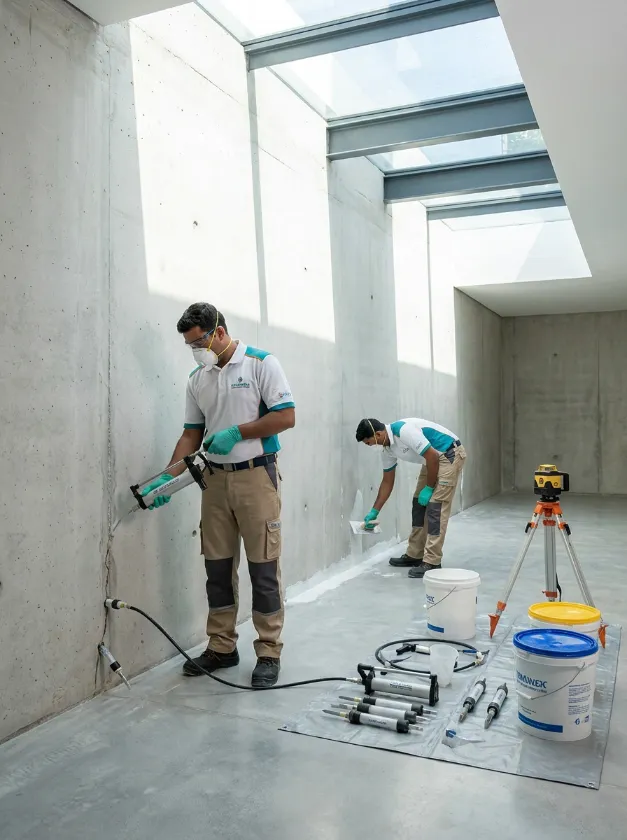
Villa basement, Jumeirah. 180 m² basement with seepage at the slab-wall junction across two elevations. Crack injection plus crystalline tanking. AED 22,000, seven working days.
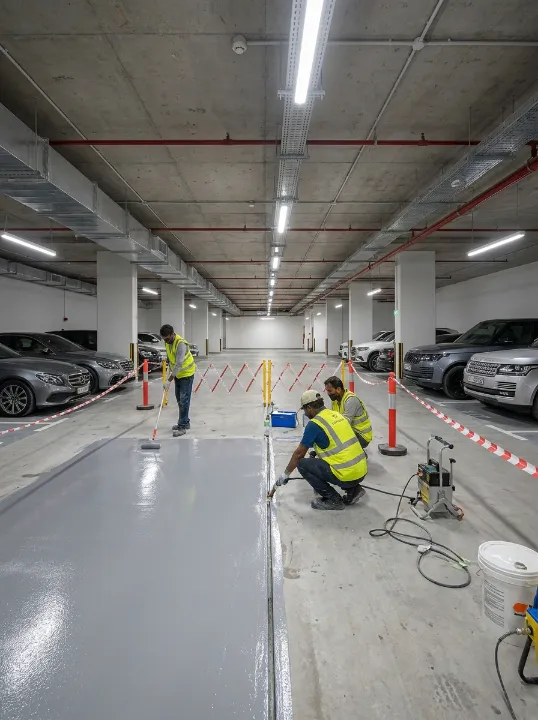
Basement car park, Business Bay. 1,400 m² level one with expansion joint leakage and ponding. PU injection to joints, liquid-applied coating to slab, phased across twenty-bay sections. AED 180,000, five weeks with the car park operational throughout.
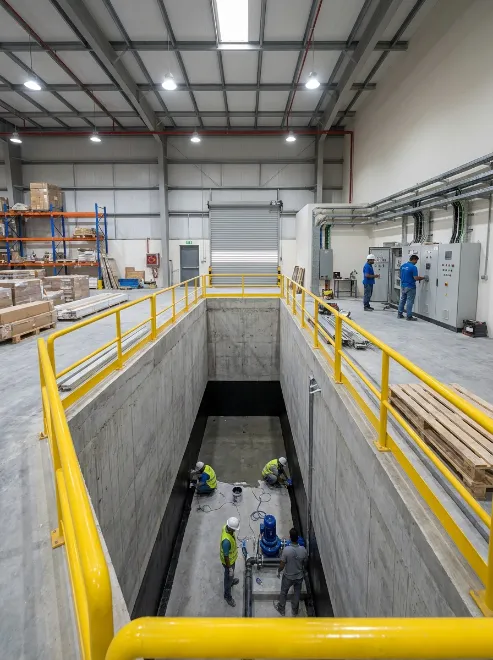
Lift pit and plant room, Al Quoz warehouse. Standing water in two lift pits and an electrical room. Concrete repair, crystalline tanking and sump pump installation. AED 34,000, nine days.
Areas We Cover Across Dubai
Business Bay
Downtown
DIFC
JLT
Jumeirah
Umm Suqeim
Emirates Hills
Palm Jumeirah
Arabian Ranches
Dubai Hills Estate
Al Barsha
Dubai Marina
Al Quoz
DIP
Jebel Ali
Industrial Zones
Dubai Silicon Oasis
Dubai South
Deira
Bur Dubai
Abu Dhabi
Sharjah
Ajman
Why Choose Dubai Technical Works for Basement Waterproofing
Below-Ground Waterproofing Specialists
Our teams work on tanking, injection grouting and drained systems across Dubai regularly, and specify by BS 8102 classification rather than by whichever product is on the van.
Fixed Quotes & Written System Specification
You receive a written specification naming the system, materials, coverage rates and area, with a fixed price per square metre. You can take that document to another contractor for comparison.
Water-Tested Handover & Written Warranty
Where the structure allows, we flood or pond test before handover and hand over photographic records with the warranty. Warranty terms are stated in writing by system type.
Customer Reviews
Two contractors had already coated our basement, and it leaked both times again. These guys did a moisture survey first, found the water was coming through a pipe penetration nobody had sealed properly, and injected it. Cost a fraction of the quotes we'd had.
Omar
Jumeirah villa
They phased our car park waterproofing twenty bays at a time over five weeks. Residents kept parking throughout, and we had one complaint in the whole project. The photographic handover record went straight into our building file.
Jennifer
Dubai Marina
FAQs
Frequently Asked Questions About Basement Waterproofing in Dubai
Cementitious tanking runs AED 45 to 90 per m², crystalline AED 60 to 120, liquid PU AED 70 to 140, and cavity drainage systems AED 120 to 250. PU injection is priced per linear metre at AED 180 to 450. Villa basements typically total AED 15,000 to 60,000.
A villa basement takes 5 to 10 working days, including preparation and curing. Crack injection alone takes 1 to 3 days. Car park and podium projects run 3 to 8 weeks depending on area and whether work is phased around occupancy. Add curing time before trafficking.
Yes, and in Dubai it usually is, because excavating around an existing building is rarely practical-negative-side systems like crystalline tanking, PU injection, and cavity drainage work from inside. Standard positive-pressure coatings applied internally will fail under hydrostatic pressure.
Not for most remedial work. Excavation gives better long-term results by keeping water out of the concrete entirely, but it costs more than the waterproofing itself on an existing building. We specify internal systems rated for negative pressure instead.
Crystalline and cementitious systems last 10 to 20 years on sound concrete. Bituminous membranes last 10 to 15 years below ground. Liquid PU coatings last 8 to 15 years. Cavity drainage lasts indefinitely, though sump pumps need replacing every 5 to 8 years.
Usually wrong system for the water pressure, poor substrate preparation, unsealed pipe penetrations, or coating applied over damaged concrete. We diagnose the specific failure before quoting, because applying a different brand of the same wrong system produces the same result.
For internal tanking, yes. The system must bond to the structural concrete, so we remove tiles, screed, plaster, and paint from the treated areas. For crack injection, no, only localised access around the crack. We confirm the extent at the survey stage.
Yes. We phase work in sections of ten to twenty bays, coordinated with your FM team with a week's notice. Mechanical ventilation runs during application, and barriers stay up until the system is genuinely trafficable, typically 24 to 72 hours.
Mostly groundwater under hydrostatic pressure, which is permanent rather than seasonal, given Dubai's high water table in coastal and reclaimed areas. Entry points are usually construction joints, pipe penetrations, and cracks rather than through sound concrete itself.
Yes. PU injection grouting seals actively flowing leaks and can be applied to wet substrate, which makes it the right emergency response. Permanent system work follows once conditions allow. Emergency attendance carries a premium confirmed before dispatch.
Managed buildings and communities require a contractor NOC, method statement, insurance documentation, and often a refundable deposit of AED 2,000 to 10,000. Dubai Municipality approval applies where works affect structure or involve excavation. We prepare and submit all of it.
Warranty terms are stated in writing by system type at the quotation stage, so you know what's covered before you commit. Coverage depends on system, substrate condition, and whether structural repair was included. We don't issue blanket guarantees on structures we haven't tested.
Book a Basement Waterproofing Survey in Dubai
Tell us the property type, approximate basement area, and what you’re seeing. We’ll arrange a free survey and issue a written diagnostic report with a fixed quote.

Dubai Technical Works provides professional technical services in Dubai and reliable handyman services in Dubai for homes and businesses. We offer AC, electrical, plumbing, painting, waterproofing, CCTV, tiling, gypsum, and property maintenance services with skilled technicians, transparent pricing, and timely solutions.
Copyright ©Dubai Technical Works Designed BY Crew Innovations