
Professional Pool Waterproofing in Dubai
Pool waterproofing in Dubai covers concrete, shotcrete, GRP and vinyl-lined pools, from full shell lining to leak detection and crack injection. Dubai Technical Works prices start from AED 180 per sqm, completes a typical villa pool in 7 to 14 days, pressure-tests every shell before tiling, and warrants systems for up to 10 years.
Call +971 55 711 3252 for a free pool survey.
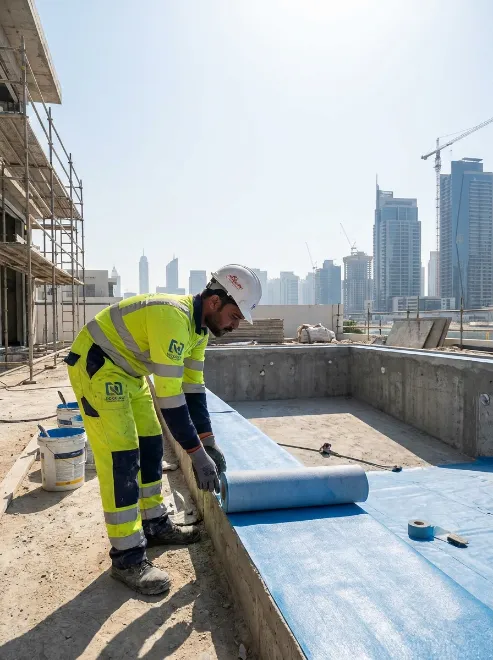
Swimming Pool Waterproofing Across Dubai and the UAE
We waterproof villa pools, rooftop and podium deck pools, hotel and resort pools, community and apartment building pools, jacuzzis, plunge pools and water features. Both overflow and skimmer systems, including balance tanks and surge tanks.
Two kinds of jobs come through. New-build waterproofing, applied to a fresh shell before tiling and commissioning. And leak repair on existing pools, where the water level keeps dropping, and nobody can say why.
Villa owners, property managers, facility management companies, hotel operators, developers and pool contractors all book with us. We cover Dubai, Sharjah and the wider UAE.
Pool work sits inside our wider waterproofing Services, so if the problem turns out to be a terrace, basement or tank rather than the pool, the same team handles it.
Is Your Pool Actually Leaking? The Bucket Test
Before you call anyone, run this. It costs nothing and takes a day.
A Dubai pool loses water to evaporation whether it leaks or not. Expect 5 to 10mm a day in summer, 2 to 4mm in winter. Anything beyond that is going somewhere else.
Fill a bucket about three-quarters full with pool water. Stand it on the top step so it is partly submerged. Mark the water level inside the bucket and the pool level outside it. Switch off the pump and leave it for 24 hours with no swimming and no topping up.
If both levels drop the same, you have evaporation. If the pool drops further than the bucket, the difference is your leak rate.
Send us that number on WhatsApp, and we can tell you roughly what you are dealing with before anyone visits.
What a Leaking Pool Costs You Every Month
Take a 40sqm villa pool losing 10mm a day beyond evaporation. That is 400 litres a day and around 12,000 litres a month.
The DEWA water bill is the smallest part of it. You are also replacing chemicals in every refill, running the heater on colder incoming water, and cycling the pump harder.
The expensive part is what the water does on the way out. Escaping water saturates the ground behind the shell, carries salts into the concrete, corrodes the rebar, and washes out bedding under the deck. A leak ignored for two seasons turns a AED 20,000 lining job into structural concrete repair.
Shell Leak or Plumbing Leak? Diagnose Before You Drain
Dye Testing the Shell and Penetrations
With the pump off and the water still, we release dye close to suspected cracks, light niches, skimmer throats, and fittings. Moving water pulls the dye into the breach, which pinpoints the exact entry rather than a general area.
Pressure Testing Return Lines, Skimmers and Main Drains
We isolate and pressure test each circuit separately: returns, skimmer lines, main drain, and vacuum line. A line that will not hold pressure is your leak, and the shell is fine.
When the Loss Is in the Balance Tank or Overflow Channel
Overflow and infinity pools lose water from the balance tank and channel more often than from the pool itself. Isolate the tank and watch the levels independently.
Roughly four in ten “pool leaks” we attend turn out to be plumbing, not the shell. Draining and relining a sound pool because one return fitting failed means spending AED 25,000 on a AED 1,500 problem. We diagnose first, every time. Our water leak detection team runs the line testing.
Where Pools Actually Fail in Dubai
Skimmer Boxes and Weir Throats
The skimmer sits at the waterline where the shell meets a plastic box, and the two materials move at different rates. Separation at that joint is the most common shell leak we find, and it usually shows as a loss that stops once the level drops below the skimmer.
Return Inlets and Wall Fittings
Every inlet is a hole through your waterproofing with a threaded fitting in it. Membrane has to be dressed into the fitting and clamped, not stopped at its edge.
Underwater Light Niches and Conduit
Water tracks into the niche, then runs out along the conduit into the ground. The pool never shows a visible crack. If your loss stops at light level, this is where to look.
Main Drains and Sump Connections
Main drain sumps sit at the deepest point under the most head pressure. The pipe-to-shell junction needs collar reinforcement, and a failure here leaks constantly at every water level.
Coping, Bond Beam and the Waterline
Deck water enters through failed coping joints and sits in the bond beam. The waterline tile band also takes the worst chemical and UV exposure in the whole pool, which is why grout fails there first.
Steps, Benches and Internal Corners
Internal corners are where coatings thin out as they are applied. Every corner, step nosing, and bench edge needs reinforcing tape bedded into the membrane.
Movement Cracks in the Shell
Thermal cycling and ground movement crack concrete. A rigid coating splits with it. Active cracks need injection and a flexible system over the top, not another coat of the same material that already failed.
Pool Types and Shells We Waterproof
Poured Concrete and Shotcrete Pools
The majority of Dubai villa pools. Reinforced concrete shells take cementitious, PU or GRP systems well, provided the substrate is sound, and the laitance is removed first.
GRP and Fibreglass Pools
Repaired with compatible GRP laminate and gelcoat rather than coated over. Putting a cementitious product on a fibreglass shell guarantees delamination.
Vinyl-Lined Pools
Liner replacement rather than coating. We inspect the shell underneath while the liner is out, because that is the only time anyone sees it.
Rooftop and Podium Deck Pools
The highest-stakes pool work in Dubai. A leak here discharges into apartments, lobbies or parking below, not into soil. These need a tanked system, full penetration detailing and a longer hold test than a ground pool.
Overflow, Infinity and Skimmer Pools
Overflow channels, infinity edges and balance tanks all need waterproofing as part of the same system. An infinity edge that is beautifully lined while the balance tank leaks has not been fixed.
Jacuzzis, Plunge Pools and Water Features
Small volumes, high heat and heavy chemical loads. Jacuzzis fail faster than main pools because of temperature cycling, and GRP lining handles that better than cementitious.
Hotel, Community and Commercial Pools
Shared pools in hotels, resorts, residential towers and gated communities. We phase the work and coordinate with facility management, so closure windows stay predictable.
Leaking Existing Pools (Re-Waterproofing)
An older pool that loses water needs the leak located before anything is re-coated. Once the source is confirmed, the old finish is removed, the shell is repaired and a new membrane goes on, followed by a water test before retiling.
Balance Tanks, Plant Rooms and Pool Decks
Leaks often start outside the main shell: in balance tanks, pipe penetrations, plant-room floors and the deck around the pool. These areas are waterproofed as part of the same system so water cannot track back under the pool.
Pool Waterproofing Systems and Where Each Belongs
GRP Lining for Leaking and Older Pools
Glass-reinforced polyester laminated into the shell, forming a jointless tanked basin that holds water independently of the structure. The strongest option for pools that have already leaked and for rooftop pools. Highest cost, longest life, 15 to 20 years.
Cementitious Waterproofing for New Shells
Polymer-modified cement slurry, brush or spray applied. Cost-effective and bonds directly to sound concrete. Right for new pools with no movement history. Lifespan 8 to 12 years, with the waterline the first area to need attention.
Polyurethane and Liquid Membrane Systems
Flexible, seamless, and able to bridge hairline cracks that would split a rigid coating. Applied under screed and tile. Our usual choice where the shell shows movement.
Polyurea Coating for Fast Turnaround
Spray-applied, cures in minutes, and gets a commercial pool back in service fastest. Expensive and needs specialist equipment, so it earns its place on hotel and community pools where downtime costs real money. See polyurea coating.
PU and Epoxy Crack Injection
Injected under pressure into active cracks and construction joints to seal from within. PU expands on contact with water, which makes it the right choice for a crack that is actively passing water.
Materials and Brands We Apply
Sika, Mapei, Fosroc, Drizoro, and BASF MasterSeal, selected for continuous immersion and chlorine resistance. We name the system on your quote. Not every waterproofing product survives permanent immersion, and plenty of cheap pool jobs use a coating never rated for it.
Chlorine, Salt Chlorination and Chemical Attack
Chlorine concentrates at the waterline where UV exposure is also highest, which is why that band degrades first on cementitious systems. Over years, it softens the surface and opens the grout.
Salt-chlorinated pools are harder on structures. The chloride load attacks rebar through any breach in the coating, and corroding steel expands and cracks the concrete from inside. If you run salt, your system needs to be chloride-resistant, and your detailing has to be faultless. Tell us which you run at the survey, because it changes what we specify.
Can You Fix a Leaking Pool Without Removing the Tiles?
Sometimes, and we will tell you honestly which camp you are in.
Targeted repair works when the leak is isolated to one crack, fitting, or light niche, the tile and bedding are sound, and the rest of the shell tests dry. Crack injection and penetration repair cost AED 2,500 to 8,000 and can be done in two to four days.
Full relining with tile removal costs AED 18,000 to 60,000 and resets the pool for 10 to 15 years.
The honest line: if your pool has leaked from two or more points, or the waterproofing is past twelve years, targeted repair buys you a season. You will be draining it again next year and paying for the tiling twice.
Draining Your Pool — the Risk Nobody Mentions
Hydrostatic Pressure and Why Shells Lift
An empty pool in the ground with a high water table can float. Groundwater pushes up under the shell with nothing inside to hold it down, and the structure lifts and cracks. It happens in Dubai, and it turns an AED 20,000 relining job into demolition and rebuild.
Before anyone pulls a plug, we check the water table and the hydrostatic relief valve in the main drain sump. Where the risk is real, we drain in stages or keep dewatering running while the shell is empty.
Where Chlorinated Pool Water Can Legally Go
Chlorinated water cannot go into a storm drain, a landscaped bed or a neighbour’s plot. It has to be dechlorinated and discharged to the correct point, and larger volumes need tankering off-site. We arrange the tanker and the access route as part of the job, which matters in gated communities where tanker access needs approval.
Transparent Pool Waterproofing Prices in Dubai (2026)
Free Pool Survey and Leak Detection
The survey is free and takes 2 to 3 hours. We run a bucket test review, dye test suspect areas, pressure test the circuits, inspect the shell, coping, and penetrations, and give you a written report naming the cause with a fixed quote.
Pool Waterproofing Price List
Scope | Price (AED) |
Leak detection and dye test | Free with quote |
Crack injection (per linear metre) | 250 – 600 |
Skimmer or light niche repair (per unit) | 800 – 2,200 |
Cementitious waterproofing (per sqm) | 180 – 300 |
PU liquid membrane (per sqm) | 240 – 400 |
GRP lining (per sqm) | 320 – 550 |
Polyurea coating (per sqm) | 380 – 650 |
Jacuzzi/plunge pool (complete) | 6,000 – 14,000 |
Small villa pool, up to 25sqm | 14,000 – 28,000 |
Standard villa pool, 30–50sqm | 22,000 – 48,000 |
Rooftop/podium pool | Quoted after survey |
Tile Removal and Reinstatement Costs
The membrane is roughly half the job. These are the line items that get left off cheap quotes.
Item | Price (AED) |
Tile removal and disposal (per sqm) | 60 – 120 |
Screed and substrate repair (per sqm) | 70 – 150 |
Pool tile supply and laying (per sqm) | 180 – 450 |
Epoxy grouting (per sqm) | 60 – 130 |
Coping replacement (per linear metre) | 220 – 500 |
Our quotes include reinstatement, handled by our own tiling and marble team.
What Changes the Quote
Pool size and depth, shell condition, how many penetrations need rebuilding, water table risk, tanker access, tile quality for reinstatement, and whether the deck and coping need addressing at the same time.
Our Pool Waterproofing Process and Timeline

Survey, Leak Detection and Fixed Quote
Dye testing, circuit pressure testing, shell and penetration inspection. 2 to 3 hours, written quote same day.

Controlled Draining and Water Table Check
Water table and relief valve checked first, then staged draining with dechlorination and tankering. One day.

Tile Removal and Shell Preparation
Tiles and failed coatings removed, laitance and contaminants stripped back to sound concrete. One to three days.

Crack Repair, Injection and Penetration Detailing
Cracks cut, injected and filled. Skimmers, inlets, lights, drains, steps, and corners detailed with reinforcement. One to two days.

Priming and Waterproofing Application
Primer, then the specified system at full coverage and thickness. Two to four days depending on system and pool size.

Curing and 72-Hour Fill Test
Full cure to manufacturer specification, then the hold test. Three to five days.

Tiling, Refill, Balance and Handover
Tiling, grouting, refill, chemical balancing, and handover with photos and warranty documentation. Three to six days.
How Long Will Your Pool Be Out of Use?
Pool | Drain & Prep | Application | Cure & Test | Refill & Reinstate | Total |
Crack injection only | 1 day | 1 day | 2 days | 1 day | 4–5 days |
Jacuzzi/plunge pool | 1 day | 1–2 days | 3 days | 2 days | 6–8 days |
Small villa pool | 2 days | 2 days | 3–4 days | 3 days | 9–11 days |
Standard villa pool | 3 days | 3–4 days | 4–5 days | 4 days | 12–16 days |
Rooftop/podium pool | 3 days | 4 days | 5 days | 4–5 days | 16–20 days |
Hotel/community pool | 3–5 days | 4–6 days | 5 days | 5–6 days | 18–25 days |
The Fill Test — Proof Before You Tile
We fill the pool, mark the water level, and leave it for 72 hours. At the end, we check the level against evaporation, inspect the surrounding ground, and, on rooftop pools, check the space below for any trace of moisture. Both ends photographed, both shared with you.
A contractor who tiles the day after the final coat has tested nothing. You find out whether the waterproofing worked once the pool is full, tiled and commissioned, which is the worst possible time and the most expensive place to be wrong.
Dubai Municipality Rules and Community Approvals
Pool Compliance for Villas and Private Properties
Private pools fall under Dubai Municipality requirements covering construction, safety and water quality. Waterproofing forms part of the structural works that must be completed correctly before commissioning.
Hotel, Community and Shared Pool Requirements
Shared and commercial pools face regular inspection, and a leaking pool with contaminated surrounds fails on both structural and hygiene grounds. We work to close windows that keep facilities compliant.
Villa Community and Building Approvals for Pool Works
Gated communities and towers want a contractor trade licence, public liability insurance, worker Emirates ID details, and often a refundable deposit before work starts. Add access routes for tanker and material delivery, agreed working hours, and waste removal routes. Approvals run 5 to 10 working days, so we start the submission the day you accept the quote.
Why Pools Fail Faster in Dubai
Evaporation, Heat and Thermal Cycling
Water temperature swings between day and night, and the shell expands and contracts with it. That cycling is what opens hairline cracks over years, and it is why flexible systems outlast rigid ones here.
Ground Salinity and Rebar Corrosion
Saline groundwater across much of Dubai drives chlorides toward the concrete. Once they reach the rebar, corrosion expands the steel and cracks the shell from inside. The waterproofing is the only barrier stopping that cycle.
UV at the Waterline and Coping Joint
The waterline band takes direct sun, maximum chemical concentration, and constant wetting and drying. Coping joints take deck heat and foot traffic. Both are the first details to fail and the first we inspect.
Best Time of Year for Pool Waterproofing in Dubai
October through April is the working window.
In summer, surface temperatures push coatings past their application limits, solvent flashes off before the film forms, and an empty shell baking at 50°C develops thermal stress cracking while it waits for the next coat.
Most villa owners want the pool ready for the cooler season, so November through February books out early. If your pool is leaking now and it is July, we stabilise it with targeted repair and schedule the full job for autumn rather than applying a system in conditions it cannot cure in.
Pool Decks, Coping and Surrounds
The coping joint is where deck water enters the bond beam, and most pool repairs skip this detail entirely. We reseal coping joints, treat the deck-to-shell junction, and apply slip-resistant sealers where decks have gone porous. Pool surrounds in heavy use benefit from epoxy floor coating, and the same team that repairs the pool handles damaged deck tile.
Recent Pool Waterproofing Projects in Dubai
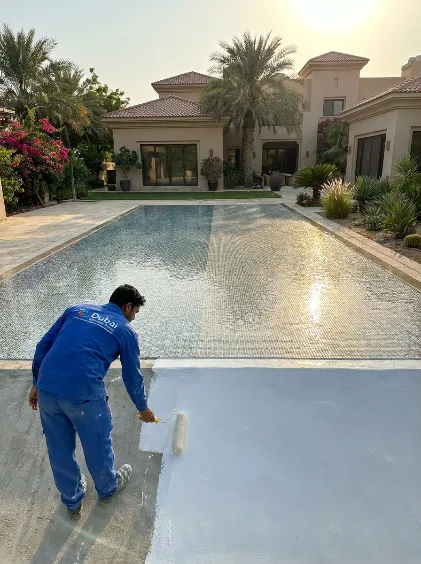
Villa, Arabian Ranches, 38sqm concrete pool. Leak traced to skimmer throat and two movement cracks. GRP lining, full tile replacement, 72-hour hold test. AED 34,500, fourteen days.
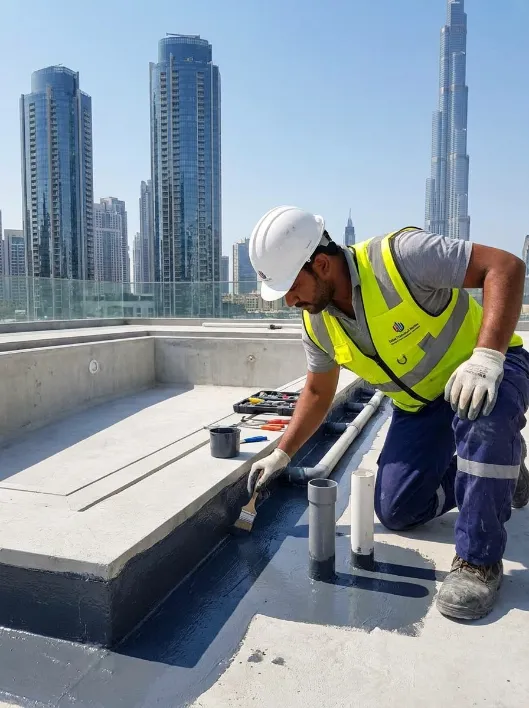
Rooftop pool, Business Bay, 22sqm. Moisture appearing in the plant room below. PU membrane with full penetration detailing and extended hold test. AED 29,800, eighteen days.
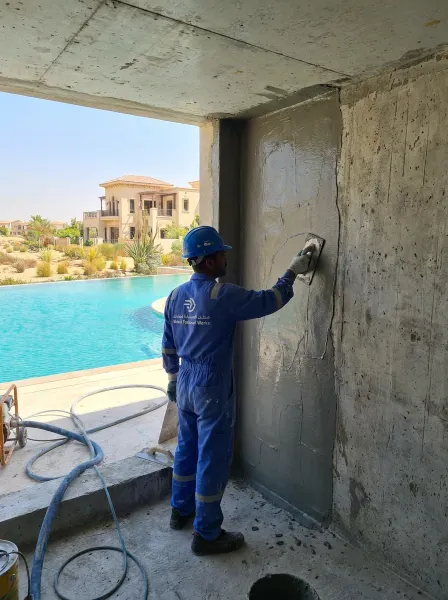
Villa, Emirates Hills, 55sqm overflow pool. Loss traced to the balance tank, not the shell. Tank lined in GRP, pool left untouched. AED 11,200, seven days.
Areas We Cover Across Dubai
Business Bay
Downtown
DIFC
JLT
Jumeirah
Umm Suqeim
Emirates Hills
Palm Jumeirah
Arabian Ranches
Dubai Hills Estate
Al Barsha
Dubai Marina
Al Quoz
DIP
Jebel Ali
Industrial Zones
Dubai Silicon Oasis
Dubai South
Deira
Bur Dubai
Abu Dhabi
Sharjah
Ajman
Why Choose Dubai Technical Works for Pool Waterproofing
Licensed, Insured Teams and Approved Applicators
Valid Dubai trade licence, public liability cover and worker insurance, with documentation ready for community and building submissions. Our applicators are trained on the systems we install.
Leak Detection Before We Recommend Relining
We pressure test the plumbing before quoting a reline. Four in ten pools we survey do not need one, and we would rather tell you that than sell you a shell lining you do not need.
Fixed Written Quotes Including Tiling and Reinstatement
The quote covers draining, tankering, strip-out, repairs, membrane, testing, tiling and grouting. If we strip the shell and find corroded rebar nobody could see, we stop and quote that separately for approval.
72-Hour Fill Test, Photographed and Signed Off
Every pool is hold-tested before tiling, photographed at both ends, and you see the result before the tilers start.
Warranty up to 10 Years by System
GRP lining carries 10 years, polyurea 7, PU membrane 5, and cementitious 3. The warranty covers membrane and workmanship failure. Structural movement from ground settlement, damage from incorrect water chemistry, and third-party drilling sit outside it, and we say so at the quote stage.
One Contractor for Waterproofing, Tiling, Plumbing and Decking
This job always needs three trades. We handle the waterproofing, the plumbing and the tiling in-house, so nobody blames the trade before them.
Customer Reviews
Two companies quoted a full reline without testing anything. These guys pressure tested the lines, found it was the balance tank, and saved me about twenty-five thousand.
Khalid
Emirates Hills
They refused to start in August and told me why. Did it in November instead, finished in fourteen days, and the pool was ready for the season.
Claire
Arabian Ranches
“Rooftop pool with damp showing in the plant room. They explained the hold test, sent photos at both ends, and the space below has been dry for two summers.
Ravi
Business Bay
FAQs
Frequently Asked Questions About Pool Waterproofing in Dubai
Cementitious systems cost AED 180 to 300 per sqm, PU membrane AED 240 to 400, and GRP lining AED 320 to 550. A small villa pool runs AED 14,000 to 28,000 complete, and a standard 30 to 50sqm pool AED 22,000 to 48,000 including tile reinstatement. Targeted crack repair starts at AED 2,500.
Run a bucket test. Float a part-filled bucket on the top step, mark the level inside and outside, switch the pump off, and leave for 24 hours. Dubai pools lose 5 to 10mm daily to evaporation in summer, 2 to 4mm in winter. Any extra drop is a leak.
Crack injection takes 4 to 5 days. A small villa pool takes 9 to 11 days, a standard villa pool 12 to 16, and a rooftop pool 16 to 20. That covers draining, preparation, application, a 72-hour hold test, tiling, and refilling. Hotel pools run 18 to 25 days.
Yes, when the leak is isolated to one crack or fitting, the tile and bedding are sound, and the rest of the shell tests dry. Injection and penetration repair costs AED 2,500 to 8,000. If the pool leaks from two or more points, targeted repair only buys you a season.
GRP lining for pools that have already leaked and for rooftop pools, since it forms a tanked basin independent of the structure. Cementitious for sound new shells. PU membrane where the shell shows movement. Polyurea where downtime costs money. The shell condition decides, not the price list.
GRP lining lasts 15 to 20 years, polyurea 12 to 15, PU membrane 10 to 15, and cementitious 8 to 12. Lifespan drops where water chemistry runs aggressive, where ground movement cracks the shell, or where penetrations were never detailed properly in the first place.
Yes, always. Tile and grout are not waterproof. Grout is porous by design and water passes straight through it to the shell beneath. The membrane goes on the prepared concrete, gets hold-tested, and only then do tiles go down over it.
It has to be dechlorinated and discharged to an approved point. Chlorinated water cannot go into a storm drain, a landscaped area or a neighbouring plot. Larger pools need tankering off-site, which we arrange along with community access approval for the tanker route.
Not indefinitely. An empty shell in high groundwater can float and crack, and an empty pool in summer heat develops thermal stress cracking. We check the water table and relief valve before draining, drain in stages where needed, and keep the empty period as short as the system allows.
Yes, and they need a different standard. A rooftop leak discharges into apartments or parking below rather than into soil, so these get a fully tanked system, complete penetration detailing, and a longer hold test with the space below inspected before sign-off.
Yes. Jacuzzis, plunge pools, spa pools, and water features from AED 6,000 to 14,000 complete. Jacuzzis fail faster than main pools because of constant heat cycling and heavier chemical loads, so we usually specify GRP lining rather than cementitious.
We fill the pool, mark the level, and hold it for 72 hours, checking the level against evaporation and inspecting the surrounding ground. It is the only proof the waterproofing works. Tiling before testing means you discover a failure once the pool is full, tiled and commissioned.
Salt-chlorinated pools carry a chloride load that attacks rebar through any breach in the coating, and corroding steel cracks concrete from inside. Salt pools need chloride-resistant systems and faultless penetration detailing. Tell us which system you run at the survey, because it changes what we specify.
Yes, up to 10 years depending on system: GRP 10 years, polyurea 7, PU membrane 5, cementitious 3. It covers membrane and workmanship failure. Ground settlement, damage from incorrect water chemistry, and third-party drilling are excluded, and we state that on the quote.
Book Pool Waterproofing in Dubai Today

Dubai Technical Works provides professional technical services in Dubai and reliable handyman services in Dubai for homes and businesses. We offer AC, electrical, plumbing, painting, waterproofing, CCTV, tiling, gypsum, and property maintenance services with skilled technicians, transparent pricing, and timely solutions.
Copyright ©Dubai Technical Works Designed BY Crew Innovations