
Bathroom Waterproofing in Dubai
Bathroom waterproofing in Dubai covers floors, walls, shower zones, sunken slabs, floor drains, and pipe penetrations in villas and apartments. Dubai Technical Works prices start from AED 1,800, completes most single bathrooms in 2 to 4 days plus reinstatement, flood-tests every membrane before tiling, and warrants systems for up to 10 years.
Call +971 55 711 3252 or WhatsApp us for a free leak survey.
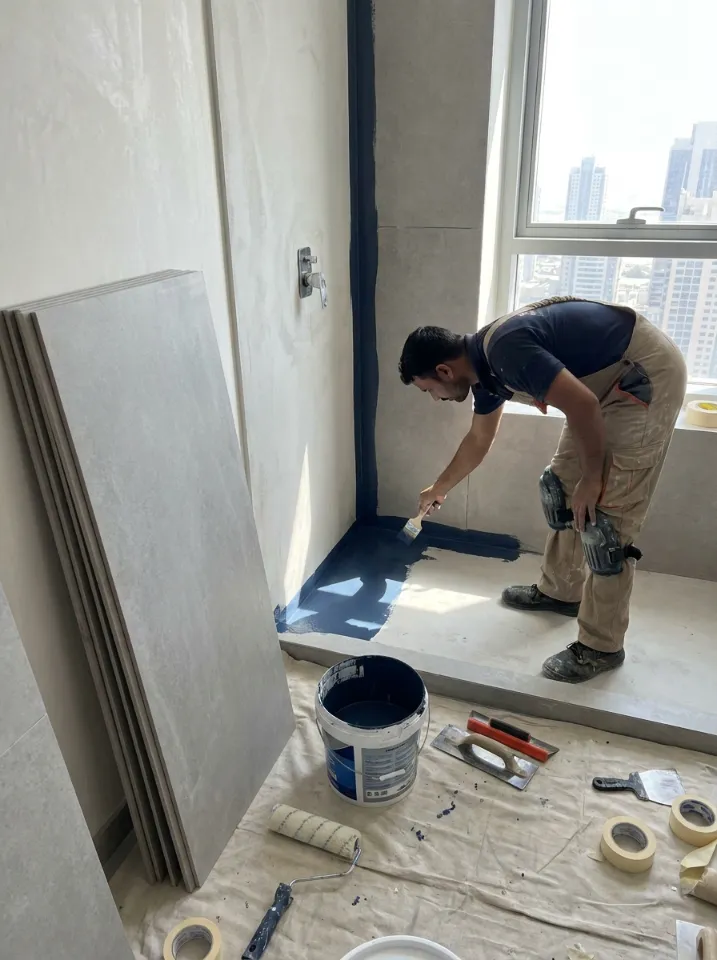
Waterproofing Bathrooms, Showers and Wet Areas Across Dubai
We waterproof bathrooms, en suites, guest toilets, walk-in showers, bathtub surrounds and sunken toilet slabs. Work covers floors, walls, floor-to-wall junctions, shower enclosures, door thresholds and every pipe penetration in the room
Clients include homeowners, tenants reporting leaks, landlords, property managers, facility management companies, hotels, restaurants and labour accommodation operators. We work in high-rise apartments, villas, townhouses, serviced apartments and commercial restrooms across Dubai, Sharjah and the wider UAE.
Two kinds of jobs come to us. Renovation waterproofing, where the bathroom is being stripped and retiled anyway. And leak repair, where water has already reached a ceiling, and somebody needs it stopped. The second is more common and more urgent, so that is where this page starts.
How to Tell Your Bathroom Needs Waterproofing
Stains on the Ceiling Below
A brown or yellow ring on the ceiling under a bathroom means water has passed the tile layer and reached the structural slab. It does not mean the stain is directly below the failure point. Water travels laterally through sunken slab backfill, so the source is often two metres away. Act on this immediately, because the slab is already wet.
Damp Patches and Blistering Paint on the Other Side of the Wall
Paint bubbling on a bedroom or corridor wall that backs onto a shower means the wall waterproofing stopped too low or was never applied above the tile line. Shower walls need membrane to at least 1.8m. Most failures we open up stop at 1.2m, where the tiler assumed the splash zone ended.
Loose Tiles, Hollow Sounds and Crumbling Grout
Tap your bathroom floor tiles. A hollow sound means the adhesive bond has failed, usually because water sitting under the tile has broken it down. Crumbling grout and tiles lifting at the shower entry are late-stage symptoms. By this point, water has been getting through for months.
Persistent Musty Smell and Mould at Junctions
Black mould in wall-to-floor corners and a musty odour that returns days after cleaning mean trapped moisture, not a cleaning problem. Check the extract fan first. A bathroom without working extraction holds humidity against every surface and accelerates sealant and grout failure.
Efflorescence and White Salt Marks
White powdery deposits on grout lines or on the ceiling below mean water is moving through concrete and carrying salts with it. This is proof of ongoing water movement, not a cosmetic issue. Painting over it achieves nothing until the membrane is fixed.
Is It the Membrane or the Plumbing? Diagnose Before You Strip
Not every ceiling stain is a waterproofing failure. A split flexible hose behind the vanity, a weeping shower mixer, or a cracked drain connection produces exactly the same symptom and costs a fraction to fix.
We pressure test supply lines, run a drain test, and use a moisture meter and thermal imaging to map where the water actually is. That survey takes 45 to 60 minutes and tells you whether you need a plumber or a waterproofing crew.
Roughly one in four leak calls we attend turns out to be plumbing, not membrane. Stripping a bathroom you did not need to strip costs AED 6,000 and a week of disruption. See water leak detection.
Where Bathrooms Actually Leak in Dubai
Floor Drains and Drain Flanges
The drain is the lowest point in the room and the hardest detail to seal. Membrane has to be dressed into the drain flange and clamped, not stopped at its edge. A membrane that finishes beside the drain funnels every drop straight into the slab.
Wall-to-Floor Junctions
This junction moves. The wall and floor expand at different rates, and a rigid coating cracks along that line within a year. The junction needs flexible reinforcing tape bedded into the membrane, not an extra coat of the same material.
Pipe Penetrations and Utility Openings
Every pipe through the floor or wall is a hole in your waterproofing. Each one needs a collar and reinforcement around it. Concealed plumbing chases cut into walls after waterproofing was applied are a common failure we find during strip-out.
Shower Hobs, Curbs and Niches
Shower niches are the most frequently botched detail in Dubai bathrooms. Water sits on the niche shelf constantly, and the back corners need full reinforcement. We find unwaterproofed niches in apartments less than three years old regularly.
Door Thresholds and Transitions
Membrane must continue past the door line and turn up at the threshold. Stopped short, water tracks under the threshold into the corridor screed, then appears in a hallway ceiling below with no visible bathroom symptom at all.
Sunken Slab Voids and Backfill
The void beneath your bathroom floor is where leaked water collects. Backfill holds it like a sponge against the structural concrete, which is why leaks here take months to appear and why drying out a sunken slab adds days to any repair.
Sunken Slab or Raised Floor? Why It Changes Everything
Most UAE bathrooms sit on a sunken slab. The structural concrete drops 150 to 300mm below the surrounding floor level, the void is filled with backfill or lightweight screed, and the tiles sit on top of that.
Water passing the tile layer does not reach the ceiling below directly. It saturates the backfill, spreads sideways to the nearest weak point in the slab, and emerges somewhere unexpected. That is why the stain shows in a corridor and not under the shower.
This changes the whole job. A sunken slab with saturated backfill needs the fill removed, the slab dried, and the void lined before anything else happens. We use GRP lining for sunken toilet slabs and tank areas because it forms a continuous tanked basin with no joints to fail.
A raised or flat floor bathroom is simpler. Strip to substrate, repair, apply liquid membrane, tile. Two to three days instead of five to seven.
We confirm which you have during the survey, and it is the single biggest factor in your quote.
Waterproofing Systems We Use and Where Each Belongs
Cementitious Waterproofing
Polymer-modified cement slurry, applied by brush or trowel. Rigid and cost-effective, and it bonds well to concrete and screed. Suited to new construction and sound substrates with no movement. Lifespan: 10 to 15 years behind tile. Lowest material cost.
PU and Polyurethane Liquid Membrane
Flexible, seamless, and the right choice where substrate movement or hairline cracking is present. It bridges cracks that would split a cementitious coat. Our default for apartment bathrooms above an occupied unit. Lifespan: 15 to 20 years behind tile.
GRP Lining for Sunken Toilets and Tank Areas
Glass-reinforced polyester laminated into the sunken void. Forms a rigid, jointless basin that holds water even if the layers above fail. The strongest system for sunken slabs and water tank areas. Highest cost, longest life, and the one we recommend where a leak has already damaged a unit below.
Crystalline Waterproofing
Reactive chemicals penetrate the concrete and grow crystals inside the capillaries, sealing the slab from within. Useful on structural concrete and where negative-side pressure is involved. We use it alongside a surface membrane rather than instead of one.
Sheet and Torch-On Membrane
Bitumen sheet, torch-applied or self-adhesive. More common on roofs and large podium areas than bathrooms, but it earns its place on large commercial wet areas and labour accommodation ablution blocks where coverage area justifies it.
Materials and Brands We Apply
Sika, Mapei, Fosroc, Drizoro and BASF MasterSeal. We apply to manufacturer specifications on coat count, thickness, and recoat timing, and we tell you in the quote which product is going down. A quote that does not name the product is hiding something.
Can You Waterproof a Bathroom Without Removing Tiles?
Sometimes. Not usually.
Over-tile liquid systems work when the tiles are sound and well bonded, the grout is intact, there is no active leak reaching the ceiling below, and the bathroom is not on a saturated sunken slab. Cost runs AED 1,800 to 3,500 per bathroom, and the system lasts 5 to 8 years. It is a sensible choice for a rental unit between tenants or a bathroom with early-stage surface seepage.
Full strip-out with membrane behind the tile costs AED 4,500 to 12,000 and lasts 15 to 20 years.
Here is the trade-off nobody explains. Over-tile coating cannot fix a failed drain detail, a cracked junction under the tile, or wet backfill. If water is already in the slab, sealing the top surface traps it. We have stripped bathrooms where a previous over-tile coating held water in for two years while the slab below quietly degraded.
If your ceiling below is stained, over-tile is the wrong answer. We will tell you that at the survey rather than take the easy sale.
Transparent Bathroom Waterproofing Prices in Dubai (2026)
Free Leak Survey and What’s Included
The survey is free and takes 45 to 60 minutes. We moisture-map the floor and walls, pressure-test accessible plumbing, inspect grout, sealant, and drain detailing, check the ceiling below where accessible, and identify whether you have a sunken or raised slab. You get a written report with the likely cause and a fixed quote the same day.
Bathroom Waterproofing Price List
Scope | Price (AED) |
Shower zone only (over-tile) | 900 – 1,600 |
Single bathroom, over-tile liquid | 1,800 – 3,500 |
Single bathroom, full strip and membrane | 4,500 – 8,000 |
Large/master bathroom, full strip | 7,000 – 12,000 |
Sunken slab GRP lining | 6,500 – 14,000 |
Wall-only treatment (shower walls) | 1,200 – 2,800 |
Per sqm, liquid membrane applied | 55 – 110 |
Per sqm, GRP lining | 130 – 220 |
What Reinstatement Costs — Tiles, Plumbing and Paint
The membrane is half the job. These are the line items cheap quotes leave out, and they are why an AED 4,500 quote becomes AED 9,000 at the end.
Reinstatement Item | Price (AED) |
Tile removal and debris disposal | 600 – 1,500 |
Floor and wall screed repair | 500 – 1,400 |
Tile supply and installation | 90 – 220 per sqm |
Sanitaryware removal and refit | 450 – 1,200 |
Ceiling repair below (gypsum) | 400 – 1,100 |
Repainting affected ceiling/walls | 350 – 900 |
Our quotes include reinstatement. See bathroom tiling, false ceiling repair and painting.
What Changes the Quote
Sunken versus raised slab moves the price most. After that: how wet the backfill is and how long it needs to dry, bathroom size, whether walls need stripping as well as floors, sanitaryware that must come out, tile quality for reinstatement, and tower access restrictions.
Our Bathroom Waterproofing Process and Timeline

Leak Survey and Fixed Quote
Moisture mapping, plumbing pressure test, substrate and drain inspection. 45 to 60 minutes, written quote the same day.

Protection, Isolation and Strip-Out
Water isolated, sanitaryware removed, floors and routes protected, tiles and failed membrane stripped to substrate. Four hours to a full day.

Substrate Repair and Slope Correction
Cracks cut out and filled, screed repaired, falls corrected to the drain. If water does not run to the drain, it sits on your membrane. We check with a level and a bucket, not by eye. Four hours to a day.

Priming and First Membrane Coat
Substrate primed to manufacturer specification, then first coat at specified wet film thickness. Skipping primer is the most common cause of membrane delamination.

Reinforcement at Every Junction and Penetration
Reinforcing tape and mesh are bedded into wall-to-floor junctions, corners, pipe collars, drain flanges, niches, and thresholds before the second coat. This step is where cheap jobs cut corners and where leaks start.

Second Coat and Cure
Second coat applied at the correct recoat interval, then full cure. 24 to 48 hours depending on system and humidity. We do not shorten this to finish early.

Flood Test, Photos and Sign-Off
Drain plugged, floor ponded, water level marked, left 24 to 48 hours. Photographed at start and finish, and we check the ceiling below. You get the photos before tiling starts.
How Long Does Bathroom Waterproofing Take?
| Scope | Membrane Work | Cure + Flood Test | Reinstatement | Total |
|---|---|---|---|---|
| Shower zone, over-tile | 1 day | 1 day | — | 2 days |
| One bathroom, over-tile | 1 day | 1–2 days | — | 2–3 days |
| One bathroom, full strip | 2 days | 2–3 days | 2–3 days | 6–8 days |
| Two bathrooms, full strip | 3 days | 2–3 days | 3–4 days | 8–10 days |
| Villa, 4+ bathrooms | 5–7 days | 3 days | 6–8 days | 14–18 days |
| Sunken slab GRP | 3–4 days | 3 days | 3–4 days | 9–12 days |
Saturated backfill adds 2 to 5 drying days before membrane work starts. We measure moisture content rather than guessing.
The Flood Test — and Why You Should Never Skip It
A flood test is the only proof your waterproofing works. We plug the drain, fill the bathroom floor with water, mark the level, and leave it for 24 to 48 hours. A pass means no drop in level beyond evaporation and no sign of moisture in the ceiling or walls below.
Here is what it costs you to skip it. The tiler covers the membrane, grout goes in, sanitaryware is refitted, and the bathroom looks finished. Eighteen months later, your neighbour’s ceiling stains and the entire job comes back out at your expense.
Any contractor who tiles the day after the second coat has not tested anything. Ask for the flood test photos before you release the tiling stage. We provide them as standard.
Dubai Municipality Rules, Building NOCs and Tower Approvals
What Dubai Municipality Requires for Wet Area Waterproofing
Dubai Municipality requires wet areas in residential and commercial buildings to be waterproofed to approved standards, with membrane continuity at junctions, penetrations, and drains. For permitted renovation work, waterproofing of wet areas forms part of the inspection scope before finishes go back.
Building NOCs, Deposits and Water Shutoff in Towers
Apartment bathroom work almost always needs a contractor NOC from building management before anything starts. Expect to provide a trade licence copy, public liability insurance, worker Emirates ID details, and a refundable deposit of AED 1,000 to 5,000 against common-area damage. You also need a booked service lift, an approved debris removal route, and coordination for water shutoff, which many towers restrict to specific hours. Contractor hours are typically 9 am to 6 pm on weekdays. Approval takes 3 to 7 working days, so start it before you schedule the job. We prepare and submit the full package.
Villa Communities and Consultant Sign-Off
Communities like Arabian Ranches, Emirates Living and Dubai Hills Estate require approval for works affecting structure or drainage, and larger scopes may need consultant sign-off. Approval typically runs 5 to 10 working days.
Apartment or Villa? The Risk Is Not the Same
Apartments — the Neighbour Below and Who Pays
In a tower, your leak becomes someone else’s ceiling. That turns a maintenance job into a dispute involving building management, two insurers and sometimes a formal complaint. Building management can restrict your water supply until the source is fixed. Move fast on apartment leaks, because the cost escalates with the neighbour’s damage, not yours.
Villas — Lateral Spread and Structural Exposure
Villa leaks spread sideways through slab and blockwork before showing. Ground floor bathrooms push moisture into adjoining wall bases, damaging skirting and swelling door frames. No neighbour pressure means villa leaks run longer before anyone acts, and the repair is usually larger by the time we see it.
Tenant or Landlord? Who Pays for a Bathroom Leak in Dubai
What Tenants Are Usually Responsible For
Minor maintenance and small repairs, commonly under a threshold of AED 500 to 1,000 stated in the tenancy contract. Blocked drains, worn silicone, and damaged grout from use typically sit with the tenant.
What Falls to the Landlord
Structural and major repairs, including waterproofing membrane failure. Under Dubai tenancy practice the landlord keeps the property fit for use unless the contract shifts that obligation. A failed membrane is not tenant wear and tear.
When Your Leak Damages the Apartment Below
Report it to building management the day you find it. Document everything with photos and dates. Liability usually follows the source, so the owner of the leaking unit carries the damage below, with building insurance or the owner’s policy responding depending on coverage. Unresolved disputes go to the Rental Dispute Settlement Centre under the Dubai Land Department. A written contractor report identifying the source is the document that settles most of these.
Why Bathrooms Fail Faster in Dubai
Constant Humidity and Poor Extract Ventilation
Bathrooms in sealed, air-conditioned apartments hold moisture when extraction is weak or blocked. Persistent surface damp accelerates grout and sealant breakdown, which is the first barrier water has to pass. See bathroom exhaust fan repair.
Thermal Movement and Hairline Substrate Cracking
Buildings move. Screed and concrete develop hairline cracks, and a rigid cementitious coat applied without crack-bridging capability splits along them. This is why we specify flexible PU on substrates showing any movement.
Salt, Efflorescence and Coastal Properties
Properties in Dubai Marina, JBR, Palm Jumeirah and Jumeirah deal with salt-laden air and groundwater salinity. Salt carried through damp concrete leaves efflorescence and attacks finishes from behind.
Chilled Water and AC Condensate in the Same Ceiling Void
Half the “bathroom leaks” we survey in Marina and Business Bay towers are AC condensate. The FCU drain pan overflows, water tracks across the ceiling void, and the stain appears near the bathroom. Rule this out before stripping anything. See AC maintenance.
The Five Most Expensive Waterproofing Mistakes
- Painting a waterproof coating over existing tiles and calling it a membrane. Surface coating on glazed tile has nothing to bond to at the grout joints where water actually enters.
- Treating grout and silicone as waterproofing. Grout is porous by design. Silicone is a movement joint. Neither is a barrier.
- Skipping reinforcement at junctions and penetrations. Flat areas rarely fail. Junctions, drains and pipe collars always do.
- No flood test before tiling. You find out through someone else’s ceiling, after the tiles are down.
- Repairing the ceiling below without fixing the source. The stain returns within weeks, and you pay for the gypsum and paint twice.
What to Check Before You Book a Survey
Five checks narrow the cause and can save you a strip-out.
- Run only the shower for ten minutes with the basin and toilet unused, then check below. Isolates shower waterproofing from plumbing.
- Turn off the vanity isolation valves for 24 hours. If the stain stops spreading, it is a supply line, not the membrane.
- Check the extract fan by holding a tissue to the grille. No suction means humidity is part of your problem.
- Inspect grout and silicone at the shower base and wall junctions for cracking, gaps or black mould.
- Ask the neighbour below when the stain appears. Only after showers points to the membrane. Constant means plumbing or AC condensate.
Membrane Lifespan and When to Redo It
A properly applied and flood-tested membrane behind tile lasts 15 to 20 years. Over-tile liquid systems last 5 to 8. Cementitious on a stable substrate runs 10 to 15.
What shortens it: substrate movement cracks, poor falls leaving standing water, failed pipe collar seals, aggressive acidic cleaning products reaching the membrane through degraded grout, and any penetration cut after the membrane went down.
A spot repair makes sense when the failure is isolated to one drain or junction, and the rest of the floor tests dry. Once two or more detail areas have failed, or the system is past fifteen years, redo the room. Patching an aged membrane buys eighteen months and costs you the tiling twice.
Recent Bathroom Waterproofing Jobs in Dubai
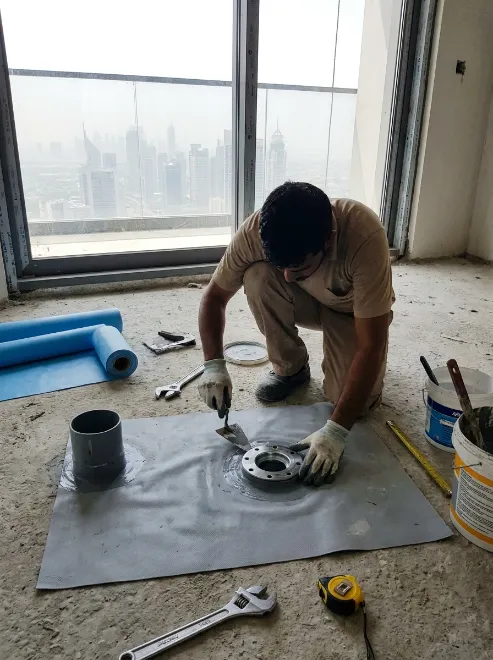
Apartment, Business Bay, master bathroom. Ceiling stain in the unit below traced to a failed drain flange on a sunken slab. Backfill removed and dried, GRP lining installed, full reinstatement including the neighbour’s ceiling. AED 11,400, eleven days.
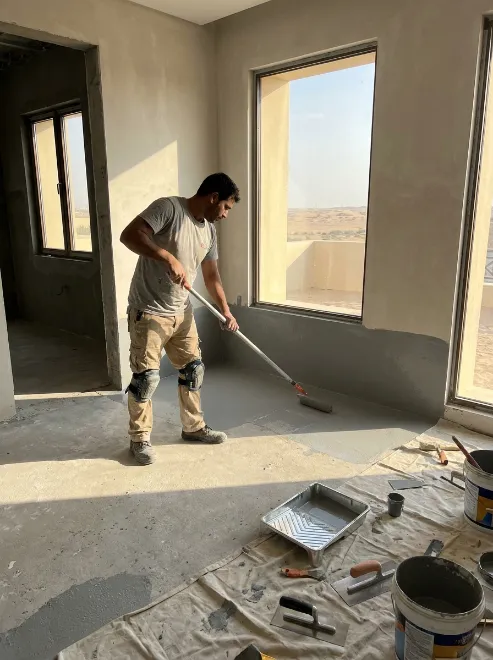
Villa, Arabian Ranches, two bathrooms. Renovation waterproofing during retiling. PU liquid membrane, full reinforcement, flood-tested before the tiler started. AED 9,200, nine days.
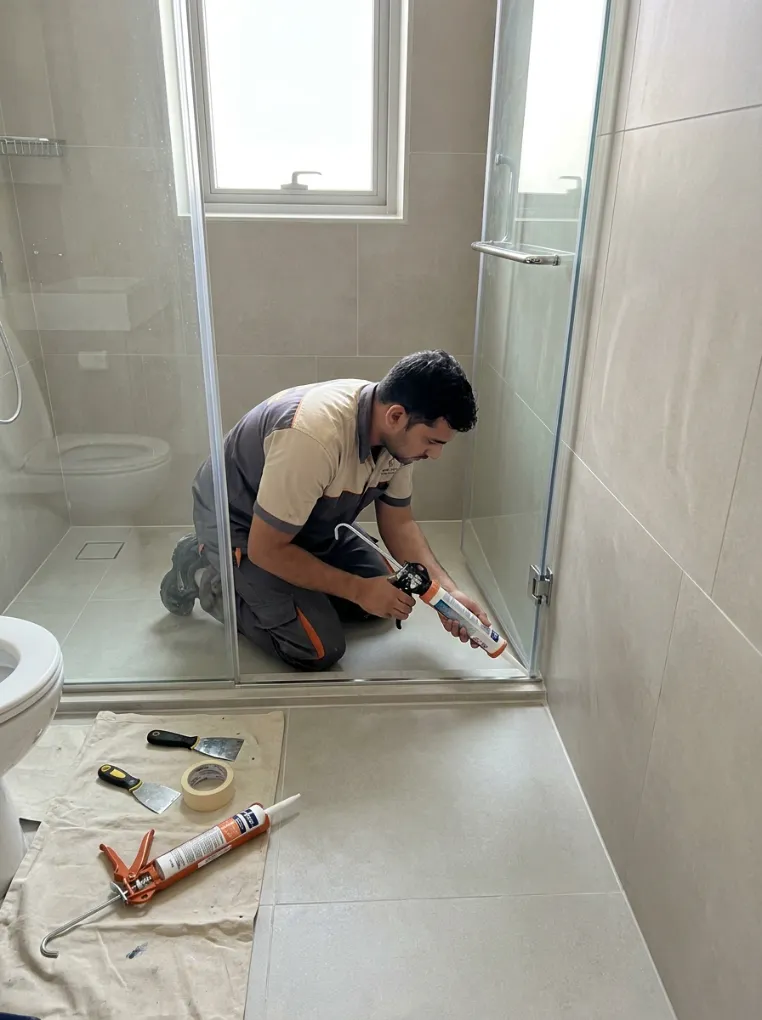
Apartment, JVC, guest bathroom. Early-stage seepage, tiles sound, no ceiling damage. Over-tile liquid system plus resealing of all junctions. AED 2,600, three days.
Areas We Cover Across Dubai
Business Bay
Downtown
DIFC
JLT
Jumeirah
Umm Suqeim
Emirates Hills
Palm Jumeirah
Arabian Ranches
Dubai Hills Estate
Al Barsha
Dubai Marina
Al Quoz
DIP
Jebel Ali
Industrial Zones
Dubai Silicon Oasis
Dubai South
Deira
Bur Dubai
Abu Dhabi
Sharjah
Ajman
Why Choose Dubai Technical Works for Bathroom Waterproofing
Licensed, Insured Teams and Approved Applicators
Valid Dubai trade licence, public liability cover and worker insurance, with documentation kept NOC-ready for tower submissions. Our applicators are trained on the systems we install rather than treating every product as interchangeable.
Fixed Written Quotes Including Reinstatement
Our quote covers membrane, strip-out, screed repair, tiling, sanitaryware refit, and making good. If we open a floor and find saturated backfill nobody could see, we stop, quote the extra drying and lining separately, and wait for your approval.
Flood Test Before Tiling, Photographed and Signed Off
Every membrane is ponded and photographed before a single tile goes down. You see the test before you pay for the tiling stage.
Warranty up to 10 Years by System
GRP lining carries 10 years, PU liquid membrane 7 years, cementitious 5 years, over-tile systems 2 years. The warranty covers membrane failure and workmanship. It does not cover damage from later penetrations drilled through the floor or walls, or plumbing failures behind the membrane, and we say so at the quote stage.
One Contractor for Waterproofing, Plumbing, Tiling and Painting
This job always involves four trades. We handle waterproofing, plumbing, tiling and marble, painting and gypsum ceiling work in-house, so nobody blames the trade before them.
Customer Reviews
Stain in our neighbour’s ceiling and building management on my back. They found it was the drain flange, not the whole floor, and documented it properly so the insurance side went smoothly.
Omar
Business Bay
Two bathrooms during a villa renovation. They flood-tested both and sent me the photos before letting the tiler in. First contractor I’ve used here who did that without being asked.
Jennifer
Arabian Ranches
I was quoted a full strip by two companies. These guys tested the plumbing first, found a cracked hose behind the vanity, and fixed it for a fraction. Saved me around nine thousand dirhams.
Rashid
JVC
FAQs
Frequently Asked Questions About Bathroom Waterproofing in Dubai
Over-tile liquid waterproofing costs AED 1,800 to 3,500 per bathroom. Full strip-out with membrane behind tile runs AED 4,500 to 12,000 depending on size. GRP lining for sunken slabs costs AED 6,500 to 14,000. Add reinstatement: tiling at AED 90 to 220 per sqm plus sanitaryware refit.
Yes, when tiles are sound, grout is intact, there is no active leak reaching the ceiling below, and the slab is not saturated. Over-tile systems cost AED 1,800 to 3,500 and last 5 to 8 years. If your ceiling below is stained, over-tile traps water in the slab and makes things worse.
An over-tile system takes 2 to 3 days including cure. A full strip and membrane on one bathroom takes 6 to 8 days including flood test and reinstatement. Sunken slab GRP runs 9 to 12 days. Saturated backfill adds 2 to 5 drying days before membrane work can start.
Ceiling stains below, damp patches on adjoining walls, hollow-sounding floor tiles, crumbling grout at the shower entry, persistent musty smell, and white efflorescence on grout or ceiling. Hollow tiles and ceiling stains mean water has already reached the slab and the repair window has closed.
Three causes: failed waterproofing membrane, a plumbing leak in supply or waste pipes, or AC condensate from a fan coil unit drain in the same ceiling void. Roughly one in four cases we survey turns out to be plumbing or AC rather than waterproofing. Diagnose before stripping anything.
Yes. Shower walls need membrane to at least 1.8m, and we carry it higher in walk-in showers with overhead rainfall heads. Most failures we open up stop at 1.2m because the original tiler assumed the splash zone ended there. Wall-only treatment costs AED 1,200 to 2,800.
Yes, and it is the only proof the membrane works. We plug the drain, pond the floor, mark the level, and leave it for 24 to 48 hours, then check the level and the ceiling below. Skipping it means you discover the failure eighteen months later through someone else’s ceiling.
PU liquid membrane for most apartment bathrooms, because it flexes with substrate movement and bridges hairline cracks. GRP lining for sunken slabs and where a leak has already damaged the unit below. Cementitious for new construction on stable substrates. The substrate decides, not the price list.
A properly applied and flood-tested membrane behind tile lasts 15 to 20 years. Cementitious systems run 10 to 15 years, over-tile liquid 5 to 8. Lifespan drops when falls are wrong and water stands, when penetrations are drilled after application, or when junction reinforcement is skipped.
Most Dubai towers require a contractor NOC from building management, a refundable deposit of AED 1,000 to 5,000, a booked service lift, and an approved debris route. Water shutoff needs to be scheduled with the building. Approval takes 3 to 7 working days. We prepare and submit the package for you.
Waterproofing membrane failure is a structural repair and normally falls to the landlord. Tenants typically cover minor maintenance below a contract threshold of AED 500 to 1,000, such as silicone, grout, and blocked drains. Check the repair clause in your tenancy contract before authorising any work.
Report it to building management immediately and document everything with photos and dates. Liability follows the source, so the leaking unit’s owner generally carries the damage below, with insurance responding depending on cover. A written contractor report identifying the cause is what resolves most disputes before they reach the Rental Dispute Settlement Centre.
Ours does. Our fixed quote covers strip-out, debris disposal, screed repair, membrane, flood test, tiling, sanitaryware refit, and making good the ceiling below. Quotes that only price the membrane routinely double at the end, since reinstatement adds AED 2,000 to 4,500 on a standard bathroom.
Yes. We work on hotel guest bathrooms, restaurant and retail restrooms, office washrooms, and labour accommodation ablution blocks. Commercial jobs are phased so the facility keeps operating, usually two rooms at a time, and scheduled outside trading hours where the site requires it.
Book Bathroom Waterproofing in Dubai Today
Tell us your property type, where the stain is showing, and when it appears. We will book a free survey and give you a written cause and fixed price.

Dubai Technical Works provides professional technical services in Dubai and reliable handyman services in Dubai for homes and businesses. We offer AC, electrical, plumbing, painting, waterproofing, CCTV, tiling, gypsum, and property maintenance services with skilled technicians, transparent pricing, and timely solutions.
Copyright ©Dubai Technical Works Designed BY Crew Innovations