
24/7 Emergency Water Heater Repair in Dubai
Emergency water heater repair in Dubai covers leaking tanks, total loss of hot water, tripping breakers, and overheating faults, handled by licensed technicians around the clock. Dubai Technical Works isolates the problem, diagnoses the fault, and repairs or replaces it on the spot. Most Dubai callouts get a technician on site within 60 to 90 minutes.
Call +971 55 711 3252 or WhatsApp us now.
What to Do Right Now, Before We Arrive
If your heater is leaking or behaving dangerously, do these four things while you wait.
Switch off the power at the isolator. Most Dubai heaters have a dedicated isolator switch outside the bathroom, usually near the door. Flip it off. If you can’t find it, trip the breaker for that circuit at your distribution board.
Close the cold water inlet valve. It’s the valve feeding the heater, usually a lever or gate valve on the incoming pipe. Closing it stops more water from entering a leaking tank.
Don’t try to drain a hot tank. Water inside sits at 60°C or higher. Let it cool for at least an hour before anyone touches the drain valve.
Contain the leak. Put a bucket or towels under the drip and move anything valuable out of the way. Ceiling-mounted units leak downward through the gypsum, so clear the floor below.
Don’t switch the heater back on to “test” it. If the breaker tripped, it tripped for a reason.
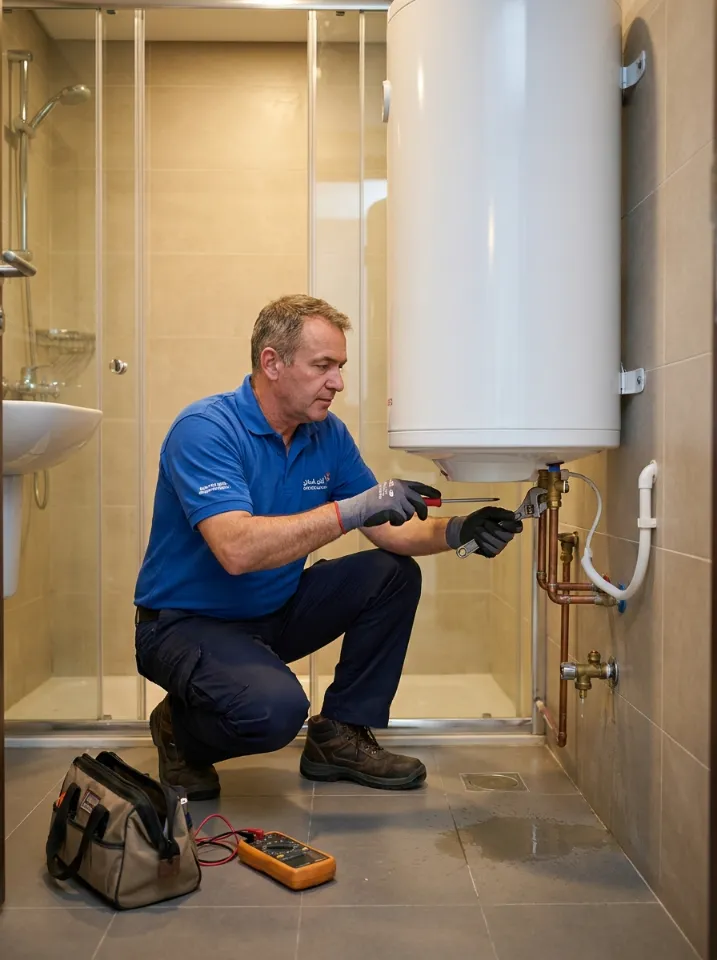
Our Emergency Water Heater Repair Services in Dubai
We handle every common emergency fault on electric, instant, solar and central systems.
No Hot Water & Heating Element Faults
The most frequent callout. Usually a burnt-out heating element, a failed thermostat, or a tripped thermal cut-off. We test the element with a multimeter before replacing anything. An element reading open circuit is a confirmed failure; anything else and the fault is elsewhere, which is why we don't swap parts on guesswork.
Water Heater Leak Repair
Leaks come from the pressure relief valve, drain valve, inlet or outlet connections, or the tank itself. The first three are repairable. A leaking tank is not, and any technician telling you otherwise is selling you a temporary patch.
Thermostat, Wiring & Breaker Tripping
A heater that trips the breaker every time you switch on almost always has a failed element shorting to earth, or water sitting where it shouldn't. This is an electrical fault first and a plumbing fault second, which is why both trades need to be on site.
Emergency Replacement When Repair Isn't Viable
When the tank is corroded through, we remove the old unit and fit a replacement on the same visit where stock allows. Full details on water heater replacement.
Is It an Emergency? Leak Severity and Fault Triage
Not everything needs a midnight callout, and we’ll tell you honestly on the phone.
Call immediately: water pouring or streaming from the unit, a burning smell, the breaker tripping repeatedly, water near electrical fittings, or a ceiling visibly sagging or staining.
Call today, but it can wait until morning: a slow drip from the pressure relief valve, no hot water with no leak present, or lukewarm water.
Book a normal appointment: water taking longer to heat, mild temperature fluctuation, or occasional rumbling noises.
A pressure relief valve dripping occasionally is doing its job. A valve streaming constantly means excess pressure in the system, and that does need attention the same day.
Signs You Need Emergency Water Heater Repair
No Hot Water at All
Sudden and complete loss of hot water points to a failed heating element, a tripped thermal cut-off, or lost power to the unit. Check the isolator switch and breaker first. If both are on and you still have nothing, the fault is internal.
Water Leaking or Pooling Around the Unit
Water on the floor below a ceiling-mounted heater, or pooling around a floor-standing tank, means something has failed. Trace whether it’s dripping from a valve, a joint, or the tank body itself, because that determines repair versus replacement.
Breaker Tripping Every Time You Switch On
An element that has shorted to earth trips the RCD instantly. Don’t keep resetting it. Repeated resets on a live earth fault are a genuine shock risk, and each reset stresses the circuit further.
Rusty Water, Burning Smell or Rumbling Noises
Rusty hot water means the tank lining or anode rod has gone. A burning smell means an electrical fault. Rumbling and popping are sediment sitting on the tank floor, boiling underneath the deposit layer.
Water Heater Types We Repair
Electric Storage Water Heaters (30L–200L)
The standard across Dubai apartments and villas, usually ceiling-mounted above a bathroom. Common faults are elements, thermostats, thermal cut-offs, and pressure relief valves.
Instant & Tankless Water Heaters
Under-sink and wall-mounted instant units found in kitchens, guest bathrooms and studios. Scale blocks the heat exchanger faster on these than on storage tanks because there's no buffer volume.
Solar & Central Hot Water Systems
Solar systems on villa roofs across Arabian Ranches and Dubai Hills, plus central hot water plant in towers and hotels. Solar faults usually sit in the circulation pump, controller or backup element rather than the panels.
Why Water Heaters Fail Early in Dubai
Dubai water carries a heavy mineral load, and that’s the main reason heaters here rarely reach their rated lifespan.
Limescale bakes onto the heating element every time it fires. Once coated, the element has to work harder to transfer the same heat into the water, it runs hotter internally, and it eventually burns out. We see elements failing at three to four years in hard-water buildings that should have lasted eight.
Sediment settles on the tank floor at the same time. That’s the rumbling sound people describe, water boiling underneath a layer of deposit. Sediment also accelerates corrosion at the tank base and eats the anode rod, which is the sacrificial part protecting the steel lining.
Then there’s placement. Most Dubai apartment heaters sit in a ceiling void above the bathroom, where ambient temperatures run high year-round. Heat and humidity there shorten the life of electrical connections and speed up external corrosion on the casing.
Ceiling-Mounted Heaters — Access and Safe Handling
If your heater is above the bathroom ceiling, the job changes. We remove the access panel, isolate power and water at the unit, and support the tank before disconnecting anything. A full 100L tank weighs over 100kg with water in it, so draining comes before removal, never after.
Two things we check that most crews skip: whether a drip tray is fitted underneath, and whether it actually drains anywhere. Plenty of Dubai installations have a tray with no outlet, which just holds water against the gypsum until the ceiling gives way. We also reinstate the access panel properly, and if the gypsum is water-damaged, our gypsum and false ceiling team repairs it rather than leaving you with a hole.
Our Emergency Repair Process & Timeline

Isolation & Safety Check
Power isolated, water supply closed, area made safe. We check for live earth faults before touching the unit. Five to ten minutes.

Diagnosis & Fault Report
Element continuity, thermostat function, thermal cut-off, wiring, and earth tested with a multimeter. Tank and valves inspected for leak source. Twenty to thirty minutes.

Fixed Quote & Approval
You get the fault explained and a fixed price before we fit anything. Nothing gets replaced without your approval.

Repair, Testing & Handover
Parts fitted, system refilled, heating cycle run and temperature checked, all connections leak-tested. Most element and thermostat repairs finish within 90 minutes on site.
Transparent Water Heater Repair Prices in Dubai (2026)
What Affects Water Heater Repair Cost
The fault, the part, the heater type, and access. A ceiling-mounted unit takes longer than a floor-standing one. Instant heaters cost more to descale than storage tanks. Solar and central systems carry higher labour costs because of system complexity.
Water Heater Repair Price List (AED)
Service | Typical Price (AED) |
Diagnosis/callout | 100 – 150 |
Heating element replacement | 250 – 500 |
Thermostat replacement | 200 – 400 |
Pressure relief valve replacement | 150 – 300 |
Drain or inlet valve leak repair | 150 – 350 |
Tank flushing & descaling | 250 – 450 |
Anode rod replacement | 200 – 400 |
Electrical fault & wiring repair | 250 – 600 |
Heater supply & installation (50–100L) | 900 – 2,200 |
Diagnosis is waived if you proceed with the repair.
After-Hours & Emergency Callout Rates
Night, weekend and public holiday callouts add AED 100 to 250 on top of the standard visit, depending on the hour and your location. We confirm that figure on the phone before dispatching, so you know the total before anyone leaves.
Get a fixed quote now. Call +971 55 711 3252.
Repair or Replace? The Honest Numbers
Repair when a component has failed and the tank is sound. Elements, thermostats, valves and wiring are all replaceable parts on an otherwise healthy unit, and a AED 300 element buys years more service.
Replace when the tank itself leaks. Corroded steel cannot be repaired, and anyone offering to weld or seal a tank is selling you weeks, not years.
The age threshold matters too. Under six years, repair almost always makes sense. Six to ten years with a repairable fault, repair if the cost stays under roughly a third of a new unit. Over ten years, or a second major fault within a year, replacement is the better spend. A new 80L heater supplied and fitted runs AED 900 to 2,200, which reframes any repair quote approaching four figures.
Who Pays — Landlord or Tenant?
In most Dubai tenancy agreements the landlord covers major repairs and replacement of fixed equipment, including water heaters, while tenants cover minor maintenance and consumables. A failed element or a leaking tank is a system fault, not routine upkeep, so it typically sits with the landlord.
Plenty of Dubai contracts now shift maintenance obligations onto tenants explicitly, often with an AED 500 or AED 1,000 threshold below which the tenant pays. Check your maintenance clause before settling the bill. We issue itemised invoices stating the diagnosed fault, which tenants regularly use to claim the cost back from a landlord or property manager.
Preventing the Next Emergency
Flush and descale the tank every 12 to 18 months in Dubai. Given the mineral content here, that interval is shorter than manufacturer guidance written for softer water, and it’s the single highest-value thing you can do.
Have the anode rod checked at the same visit. It’s a sacrificial part designed to corrode instead of your tank, and once it’s gone, the tank starts rusting. Replacing an AED 300 anode rod is considerably cheaper than replacing a tank.
Fit a drip tray with a proper drain outlet under any ceiling-mounted heater, and consider a leak sensor. Both are cheap, and both prevent the ceiling collapse scenario. Annual servicing catches element degradation, valve wear, and loose electrical connections before they become 2am callouts.
Property Types We Serve Across Dubai
Villas & Townhouses
Multiple heaters across bathrooms, plus solar systems on roofs. Villas often run two to four units, and we check them all while on site rather than charging separate callouts.
Apartments & Studios
Ceiling-mounted storage units and under-sink instant heaters. We coordinate building access and service lift bookings with facilities management directly.
Hotels, Clinics & Commercial Properties
Central hot water plant, multi-unit systems and high-demand installations for restaurants, salons and staff accommodation. Downtime costs money, so commercial jobs get priority scheduling.
Areas We Cover Across Dubai
Dubai Marina
Business Bay
JLT
Arabian Ranches
Dubai Hills Estate
Emirates Hills
Palm Jumeirah
Al Furjan
JVC
JVT
Mirdif
Al Barsha
Motor City
Deira
Bur Dubai
Al Karama
Al Satwa
Al Quoz
Al Nahda
International City
Discovery Gardens
Dubai Silicon Oasis
Dubai Investment Park
Dubai Creek Harbour
Sharjah
Fujairah
Ajman
Abu Dhabi
Why Choose Dubai Technical Works for Emergency Water Heater Repair
Licensed Technicians for Electrical & Plumbing Work
Water heater faults sit across both trades. Our technicians are qualified to isolate, test, and repair the electrical side as well as the plumbing, so you don't need two separate callouts.
Fixed Pricing Confirmed Before Dispatch
You get the callout figure and a repair price range on the phone, including any after-hours premium, before a technician leaves. No open-ended emergency billing.
Genuine Parts & Written Warranty
We fit genuine elements, thermostats, and valves rather than cheap equivalents that fail within months. Every repair carries a written workmanship warranty, and we return at no charge if the same fault recurs.
Customer Reviews
Tank started dripping through the bathroom ceiling at 11pm. They talked me through shutting the isolator and inlet valve on the phone, arrived within the hour, and had it replaced by 2am. Charged what they quoted including the night rate.
Hamad
JVC
Our element burnt out twice in three years. This time the technician showed me the scale on it and explained we'd never had the tank flushed. Descaled it, replaced the anode rod, and it's been fine since.
Lara
Dubai Marina
FAQs
Frequently Asked Questions About Emergency Water Heater Repair in Dubai
Most repairs run AED 150 to 600 depending on the fault. Element replacement costs AED 250 to 500, thermostats AED 200 to 400, valve leaks AED 150 to 350. Diagnosis is AED 100 to 150, waived if you proceed. After-hours callouts add AED 100 to 250.
Most Dubai locations get a technician within 60 to 90 minutes, day or night. We confirm a realistic arrival window when you call rather than promising a figure we can't hit. Tower properties can take longer if building access needs arranging.
Yes, immediately. Switch off the isolator outside the bathroom or trip the breaker, then close the cold water inlet valve feeding the heater. Don't attempt to drain a hot tank, and don't switch the unit back on to test it. Contain the leak and call us.
Almost always a heating element that has shorted to earth, or water reaching an electrical connection. Both are genuine shock risks. Stop resetting the breaker, leave it off, and get it tested. An element reading continuity to earth confirms it and needs replacing.
It depends where the leak is. Pressure relief valves, drain valves, and pipe connections are all repairable at AED 150 to 350. A leak from the tank body itself cannot be repaired, because the steel has corroded through. That unit needs replacing.
Element and thermostat replacements take around 90 minutes on site, including testing. Valve repairs take 45 to 60 minutes. Full descaling runs two hours. A ceiling-mounted replacement takes three to four hours, including draining, removal, and fitting.
Repair if the tank is sound and the unit is under six years old. Between six and ten years, repair if the cost stays under roughly a third of a new unit. Replace if the tank leaks, the heater is over ten years old, or it's the second major fault in a year.
Rated lifespans of eight to twelve years rarely hold here. Dubai's hard water means limescale and sediment shorten that considerably, and we regularly see units failing at five to seven years. Flushing every 12 to 18 months and replacing the anode rod extends it meaningfully.
Rust in hot water only means the tank lining is corroding and the anode rod has been consumed. Check whether cold water runs clear; if it does, the heater is the source. This is usually a sign the tank is near end of life rather than a repairable fault.
Yes, AED 100 to 250 on top of the standard visit depending on the hour and location. We tell you that figure on the phone before dispatching a technician, so the total is agreed before anyone arrives. Nothing gets added afterwards.
Usually the landlord, since a heater is fixed equipment and a failure is a system fault rather than routine maintenance. Many Dubai tenancy contracts set a threshold, often AED 500 or 1,000, below which the tenant pays. Check your maintenance clause. We provide itemised invoices for claims.
Yes. Solar system faults usually sit in the circulation pump, controller, or backup electric element rather than the panels themselves. We also service central hot water plants in towers, hotels, and commercial buildings, quoted after a site assessment.
Water Heater Care & Plumbing Insights
For non-urgent work, see water heater installation, water heater replacement, and solar water heater repair. For other urgent plumbing faults, our emergency plumber and water tank repair teams operate on the same 24/7 line.
Call for Emergency Water Heater Repair in Dubai Now
Tell us what’s happening and where you are. We’ll confirm an arrival window and a price, including any after-hours rate, before a technician leaves.

Dubai Technical Works provides professional technical services in Dubai and reliable handyman services in Dubai for homes and businesses. We offer AC, electrical, plumbing, painting, waterproofing, CCTV, tiling, gypsum, and property maintenance services with skilled technicians, transparent pricing, and timely solutions.
Copyright ©Dubai Technical Works Designed BY Crew Innovations